Showing posts with label Karol Ruth Silverstein. Show all posts

Thursday, April 24, 2025

Are Disability Stories in Kid Lit (Finally) Having a Moment?

Looking back at the books I read last year and loved, I was pleasantly surprised to find so much disability representation. True, I do tend to seek out these books, but it definitely seemed like there were a lot available to reach for. The titles that blew me away were also predominantly written by authors writing, at least in part, from their own lived experience. Sweet!


CURSED book cover.
As recently as six years ago, when my own based-on-lived-experience debut YA Cursed came out, there were not as many disability-themed kid lit titles to choose from. The titles that were available were largely written by and featuring cis/het white folks and often weren’t written by authors who identify as disabled or neurodivergent. Both of those statistics are beginning to change—but very slowly. Still, it’s great to see progress happening.

Interested in reading more #DisLit? Here’s bit about the books I’ve read recently and recommend to get you started:


Published in 2024

  • The five book covers mentioned in the text on a dark green background
    2024 was a BANNER year for disability rep in kid lit!
    Joined at the Joints by Marissa Eller. A swoony romance featuring a main character with juvenile arthritis and anxiety. 
  • Chronically Delores by May Van Wagenen (2025 Schneider Family Book Award winner). Delores, who has  interstitial cystitis, launches a mutually beneficial partnership with new autistic friend Terpsichore, from which both teens hope to benefit.
  • Light Enough to Float by Lauren Seal (2025 Schneider Family Book Award honor book). Painfully real depiction of living with anorexia, told in verse.
  • Bitsy Bat, School Star by Kaz Windness. Described as “from an autistic perspective” by the autistic author, Bitsy finds school way too stimulating for comfort but nevertheless finds a way to shine.
  • Next Level: A Hymn in Gratitude for Neurodiversity written by Samara Cole Doyon and illustrated by Kaylani Juanita. A joyful book that invites readers to “level up” and witness our shared humanity.

Published in other years but read by me in 2024:


  • The five book covers mentioned in the text on a dark purple background
    GREAT disability rep! GREAT reads!
    Good Different by Meg Eden Kuyatt  (2024 Schneider Family Book Award honor book). A novel-in-verse about a neurodivergent girl who comes to understand and celebrate her differences. (2023)
  • No Matter the Distance by Cindy Baldwin. A novel-in-verse about a kid with cystic fibrosis who forms a special bond with an ill dolphin. (2023)
  • Aniana del Mar Jumps In by Jasminne Mendez (2024 Pura Belpré Honor book), a novel-in-verse about a 12-year-old Dominican American swimmer who is diagnosed with Juvenile Arthritis. (2023)
  • How it Feels to Float by Helena Fox. One of the most illuminating and empathetic depictions of schizophrenia I’ve ever encountered. (2019)
  • Lover Birds by Leanne Egan—a sapphic enemies-to-lovers story set in Liverpool featuring a powerful portrayal of ADHD. (2025)

Note: You may have noticed a lot of novels-in-verse in the list above. Not only do I love the form, but my current work-in-progress is a verse novel. 


Wish me luck—and happy reading!


Karol Ruth Silverstein's author photo. She's a white woman with wavy brown hair, wearing blue glasses and a lavender top emblazoned with the word "PROUD." The "O" on proud is a dynamic wheelchair icon.


KAROL RUTH SILVERSTEIN is an award-winning children's book author and disability activist. She lives in West Hollywood, CA with two impossibly fluffy cats. 

Thursday, April 17, 2025

Get Creative With Your Creative Accountability

My head likes to lie to me. It says:

You’re lazy.

You don’t write enough.

You’re not a real writer.


What I’ve come to learn—in life as well as in my creative endeavors—is that my head can be an unreliable narrator at best and a bully at worst. It will present False Evidence Appearing Real (FEAR) and taunt me with Shoulda Already Mastered Everything (SHAME). It’s sometimes an unsafe neighborhood to hang out in, which is challenging for me because it’s where all my best ideas, characters, scenes, snarky quips and plot twists live.


Due to a number of factors (some in my control, others not), I likely write less than the average professional author. But I DO write, stringing words into sentences, sentences into paragraphs, paragraphs into pages, and pages into full manuscript drafts, long and short. Regardless of what my head would have me think, I’m not lazy, I do get a lot of writing done, and I am a real writer.


My head can be relentless, though, so I needed a way to reassure myself and to provide clear evidence of all the work I was doing. To that end, I developed a new practice after a casual conversation with my mom. (Moms are special that way, aren’t they?) She was telling me about a composer she liked who’d mentioned in an interview that he puts a checkmark in his calendar for every day he worked on his music.


October calendar page with large and small star stickers on most days and misc. other markings.
Oct 2021 creative accountability
calendar page


Checkmarks seemed a bit dull for me, so I used colorful star stickers I had on hand, “awarding” myself a star for every day I wrote. Before long, I thought why stop at merely marking writing days? How about days with author activities, artist’s dates, drawing for fun? Heck, I stuck swim days and social activities in there too, as both contribute to my mental health and ability to re-fuel creatively. 

Add in the occasional hand-drawn doodle or mini-photo, and these creative accountability calendars started being not only really fun—but opportunities for additional creativity! 


Photo of various mini-sticker sheets including books, pencils, hearts, stars, the letter Z, etc. Insert in top left corner shows what each sticker stands for.
My min-sticker collection

I upped my sticker game too, using super cute pencils, books, hearts and more—all purchased on Etsy, so I’d be supporting indie artists. 

Now when my brain tries to tell me I’m lazy, I need only to glance at my Creative Accountability Calendar right beside my desk to prove my head wrong. I share photos of my calendar on line, at first worrying that it would seem like I was bragging or something, but being reassured by friends that it was fun and inspiring.


April calendar page with various stickers on most days along with misc. other markings.
April 2024 creative accountability calendar page
I urge you to give this a try if you have a bully brain like mine—or if you just like keeping track of work in a fun, arty way. There’s no right way to do it, no rules. Maybe the simple checkmarks work for you? Or maybe you want to draw your own symbols or make your own stickers? Just have fun with it. 

Personally, I love looking at all the stickers I’ve “earned” in a given month, and I bet you will too!

Karol Ruth Silverstein's author photo. She's a white woman with wavy brown hair, wearing blue glasses and a lavender top emblazoned with the word "PROUD." The "O" on proud is a dynamic wheelchair icon.


KAROL RUTH SILVERSTEIN is an award-winning children's book author and disability activist. She lives in West Hollywood, CA with two impossibly fluffy cats. 

Thursday, April 10, 2025

The Spoon Theory—It’s Not Just For Disabled Folks!

Ever catch someone identifying as a “spoonie” in a social media bio? Confused? Curious? Allow me to explain.

There’s an essay that’s become well known among disabled people called The Spoon Theory, written by Christine Miserandino for the But You Don’t Look Sick blog. In it, she creates a metaphor wherein spoons represent one’s physical and mental energy. Having lunch with a friend who’d asked what it’s really like to be disabled, she explained that when you’re disabled, you have a limited number of spoons. On any given day, you have figure out how many spoons you expect to have and how many spoons each activity you have planned might take. If you have way too much planned for the available spoons, you need to adjust your plans accordingly.


Graphic showing black stick figures with "low battery," slumped at a desk with a large pile of paperwork and napping in bed. Text reads" Low on physical & mental energy? Falling asleep at your desk? Maybe a nap would help!

It’s basically time and energy management, and while some people can get away with “winging it”—pushing through exhaustion or adjusting their schedules on the fly—that approach can spell disaster for others, particularly many disabled people. Personally, I find the analogy extremely helpful for explaining to able-bodied friends why it's so difficult for me say yes to spur-of-the-moment plans. Sometimes these invites feel like my buddies are suggesting I defy gravity! I often direct friends to the spoon theory essay to help them understand me more fully.


I’ve also found an understanding of the limited spoons I might have on a given day helpful in combatting the feeling that my not doing enough is some kind of moral failing. I can’t paint a whole house with one gallon of paint. That’s just math. But I might be able to tackle one room, and by setting a more feasible goal, I’m practicing gentle self-care and avoiding any mental-energy-sapping moral judgement that stands to derail me.


Recently an able-bodied artist friend was struggling with her own moral judgement around not accomplishing enough. This friend has a husband, a dog, a home needing routine maintenance and a day job—all of which require time and energy, i.e. a certain number of spoons. I could see that her mental energy, or bandwidth, was a real factor for her. I introduced her to The Spoon Theory and suggested she use it to make a more realistic goals and let go of unrealistic shame. Creating takes focus! Sometimes we may have physical strength leftover but our minds need rest.


Try the following exercise: 

Graphic with 15 different types of spoons and "to do list" type categories. Text reads: "Available spoons" and "Do you have enough?"

Start with maybe 15 spoons for a given day and breakdown how many are needed for the various things on your schedule. Remember to consider both physical and mental energy. Tackle the “must do” agenda items first, and see how many spoons you have left for the rest. Do you have enough spoons for your art? If not, can you rearrange your schedule a bit? Maybe you can and maybe you can’t, but please remember: not getting to your art (or only getting to a little) on a day chock full of unavoidable activities isn’t a moral failing. It’s you being human.


Have fun—and now I gotta go. I’m totally out of spoons!


Karol Ruth Silverstein's author photo. She's a white woman with wavy brown hair, wearing blue glasses and a lavender top emblazoned with the word "PROUD." The "O" on proud is a dynamic wheelchair icon.


KAROL RUTH SILVERSTEIN is an award-winning children's book author and disability activist. She lives in West Hollywood, CA with two impossibly fluffy cats. 

Thursday, April 3, 2025

Lessons in Resiliency From Bozo the Clown

Graphic drawing a Bozo the clown punching bag toy.

Growing up, I had this Bozo the Clown punching bag toy. Tube-shaped and made of hard rubber, it stood about four feet tall and had a weighted bottom. It was painted with Bozo’s likeness, with 3D orange clown hair sticking out on either side of his head, a honkable red-ball nose, wide eyes and an exaggerated smile. The idea was to sock Bozo right in the face—possibly not a toy today’s parents would embrace—making him flail backward. But he’d always bounce right back up due to the weighted bottom, and always with that same goofy grin.


Thank you Universe. May I have another?


Graphic with three photos of Karol playing Dolly in her 6th grade play. A theater marquee graphic reads: "Annie Get Your Gun, 1975."
Stealing scenes as Dolly

Throughout my life, I’ve felt a kinship with these Bozo toys—getting knocked down but always bouncing back up, my undying willingness to try again intact. In my sixth grade graduation play, I was not cast as the lead in Annie Get Your Gun as I’d hoped, but instead tagged for the comical supporting role of Dolly. After a good sulk, I decided I’d be the best darn Dolly I could be and went on to steal most of the scenes I was in. 

Okay Universe. Watch me now.


My journey to becoming a published author began with a mostly unsuccessful attempt at a screenwriting career. After being knocked down countless times by near-misses and consolation prizes, I shifted my focus (i.e. bounced back) to writing books for kids. Guess what? I continued to get knocked down and had to continue bouncing back up. Somewhere along the line, I realized this was sort of my thing. I would not give up, would not lose hope. There would always be a different approach or another angle I could try. And I did—again and again. 

Howdy Universe! Guess who? 


Luckily, after signing with an agent whose resiliency rivaled my own and a new series of bounce-backs, we sold my debut YA novel, Cursed. I had a great experience working with my editor and publisher, and the book went on to win a big award. Whew! I’d made it! 


Alas—the punches to the face did not cease. Life generally doesn’t work that way, particularly for artists. There will always be hurdles, crushing near-misses, confidence-rattling disappointments. So what’s a tired punching bag clown to do? Keep writing. Keep bouncing back up. Keep relying on that weighted bottom to provide the momentum and balance needed to try again, to believe that a victory is not only possible but might be right around the next corner.


My metaphoric weighted bottom consists of a mix of encouragement in my early childhood, my innate stubbornness, a host of supportive friends who believe in me and the determination gained and strengthened by my managing life with a disability. It hasn’t failed me yet. But what if your weighted bottom feels lacking in heft? 


How might you build it into the gargantuan glutes necessary for an artist in an exceptionally difficult field? Give it a think, take any necessary actions and keep bouncing back.

Watch out Universe. Here we come…


Karol Ruth Silverstein's author photo. She's a white woman with wavy brown hair, wearing blue glasses and a lavender top emblazoned with the word "PROUD." The "O" on proud is a dynamic wheelchair icon.

KAROL RUTH SILVERSTEIN is an award-winning children's book author and disability activist. She lives in West Hollywood, CA with two impossibly fluffy cats. 

Tuesday, June 13, 2023

Disability Dispatch: Disabled Authors Speak Their Truths

In this discussion with Keah Brown, Natalia Sylvester, and Jen Wilde, moderated by Karol Ruth Silverstein, these four disabled authors discuss their books, careers, and the joys and challenges of telling authentic disability stories for young people. If you haven't seen this SCBWI Digital Workshop yet, I highly recommend it!

As the panel description says, "Disability inclusion in children’s books is no longer niche—it’s necessary!"

screen shot from the SCBWI digital workshop panel, Disability Dispatch - full description in the blog post below

There were so many great moments in the discussion, including:

Keah Brown's response to someone telling her their book made them so angry they burned it: "Thank you for purchasing it."

And Natalia Sylvester decoding the criticism they faced when a reader wanted the book to be 'just' about disability (and not intersectional), was that reader wanting the book to more closely reflect their own white experience.

Watch the full video here.

Illustrate, Translate, and Write On,
Lee

Thursday, January 27, 2022

Managing Missteps…Oh My!

I have a confession: I read reviews. I know I shouldn’t. I’ve been strongly advised against doing so, but at a certain point I made the decision that, for me, the thrill of a good review outweighed the sting of a bad one. 


A scale with excerpts from good reviews on one side and bad on the other showing the good outweighing the bad.
Particularly thrilling are the “good reviews” where readers with disabilities and chronic illnesses say that my book makes them feel seen and represented in ways they rarely do, thereby letting me know that my aspiration to lift up my community and tell our stories authentically is on track. 


That’s why it’s so uncomfortable when I’m made aware of a misstep. 


Since its publication, I’ve learned that my novel Cursed has a level of ableism that doesn’t sit well with some readers. There was some ableism I wasn’t even aware of. For example, I’d used the words “crazy” and “insane” throughout the book, only learning after the fact that doing so perpetuates the stigma around mental health conditions. Charlesbridge Teen offered to swap out those words in the Cursed paperback, for which I was incredibly grateful.


Conversely, I’d made a conscious decision to include a good bit of internalized ableism in the story. My main character Ricky was able-bodied for the first 13 years of her life, as was I. Thus, following her chronic illness diagnosis, she had to deal with a lot of internalized ableism. I thought it was important to show her growth through and beyond that. 


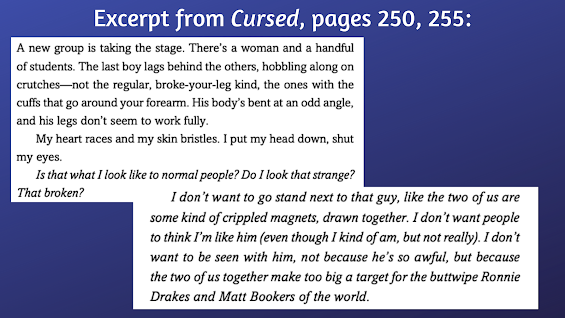
I struggled with one scene in particular where her journey comes to somewhat of a head. Ricky eventually course-corrects her ableist assumptions, but as I was editing, I wondered: Does this go too far? 


Excerpt from the novel, Cursed. Text reads: "I realize I missed a whole school while my head was spinning. A new group is taking the stage. There’s a woman and a handful of students. The last boy lags behind the others, hobbling along on crutches—not the regular, broke-your-leg kind, the ones with the cuffs that go around your forearm. His body’s bent at an odd angle, and his legs don’t seem to work fully.  My heart races and my skin bristles. I put my head down, shut my eyes.  Is that what I look like to normal people? Do I look that strange? That broken?  I don’t want to go stand next to that guy, like the two of us are some kind of crippled magnets, drawn together. I don’t want people to think I’m like him (even though I kind of am, but not really). I don’t want to be seen with him, not because he’s so awful, but because the two of us together make too big a target for the buttwipe Ronnie Drakes and Matt Bookers of the world."


I asked a disabled friend to read the scene, and he thought I was okay. In retrospect, I realized that the friend I’d asked has incredibly thick skin. Maybe I should have consulted additional readers, particularly teens? Maybe I should have taken my own discomfort with the scene as an indication that I should tone it down a tad?


But I didn’t do any of that.


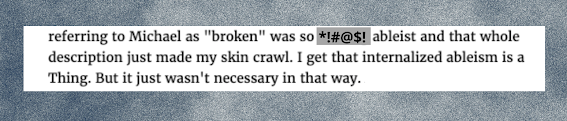
And a recent GoodReads reviewer let me know that, in his eyes, I’d messed up. 


Excerpt reads: "referring to Michael as 'broken' was so *!#@$! ableist and that whole description just made my skin crawl. I get that internalized ableism is a Thing. But it just wasn't necessary in that way."
Excerpt from the GoodReads review. 


Ouch. For me—but more importantly, for him.


The review itself was generous, 4 out of 5 stars, with the reviewer noting that he has cerebral palsy and saying I’d really gotten the “living with chronic pain” experience right. 


Ultimately, I stand by the scene, while also accepting that I let this reader down—someone thrilled to see himself accurately reflected, finally...only to get what felt like a slap in the face later on in the book.


The moral of this awkward story is that—whether we’re intentionally pushing boundaries in an attempt to make a point or unknowingly using harmful stereotypes and insensitive language when we really should have known better—none of this stuff is easy.


I do my best. That’s all any of us can do.


My thanks to Lee Wind for inviting me to share some of my thoughts here on the Official SCBWI Blog this month.


Happy creating everyone!


Photo of author Karol Ruth Silverstein wearing a light purple disability pride t-shirt.
KAROL RUTH SILVERSTEIN (she/her/disabled) is a screenwriter and writer of various genres of children’s books. Originally from Philadelphia, Karol now lives in West Hollywood with her incredibly fluffy cats, Ninja and Boo.

Follow her on Twitter @KRSilverstein, 

Instagram @KRSilverstin2019 and 

Facebook AuthorKarolRuthSilverstein.


For interviews, author videos, disability-related articles, upcoming events, etc. go to www.karolruthsilverstein.com

Thursday, January 20, 2022

I Can’t Draw (Or So I Thought)

**Alt text included for all photos.

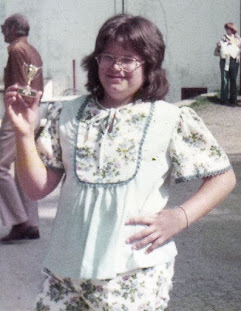
Author Karol Ruth Silverstein pictured as a chubby 9 year old in a 70s style outfit, holding up a tiny trophy.
Me at about 9 years old, proudly
holding the trophy I got for 
singing in the school chorus.

As anyone who’s ever been in a vehicle with me can attest—I love to sing, loudly and unabashedly. From as far back as I can remember, singing has brought me immense joy. But here’s the thing: my singing voice is merely blissfully mediocre. I have zero aspirations or potential as a vocalist beyond making myself happy. Ah—SUCH freedom!


Like a lot of kids, art was a big part of my grade school experience, but after sixth grade, I put my paints and markers and crayons away because, well, I can’t draw.


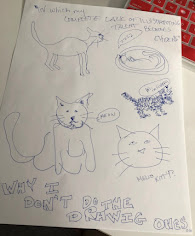
Flash way…WAY…forward to 2020. I was wading through the early days of the pandemic, as we all were, trying to stay safe, combat boredom and keep my spirits up. Jenn Reese, an author/illustrator I follow on Facebook, was doing weekend creative challenges, poems or stories on Saturdays and illustration prompts on Sundays. I was having tremendous fun with the Saturday challenges but skipping Sundays, obviously, because…I can’t draw. 


Several rough drawings in of cats in various poses, accompanied by text: "In which my complete lack of drawing talent becomes evident" and "why I don't do the drawig ones (sic)"
My first art challenge attempt.
(I was so nervous, I spelled 
drawing wrong.)

I honestly don’t remember why, one Sunday, I spontaneously decided to try the drawing challenge. Boredom maybe? The result was…pretty dreadful.


But something shifted or got cleared away or opened up or…something. I kept doing the art challenges. Occasionally I’d come up with a rather nice drawing, only to be followed by chicken scratch the next week. But I was having FUN and, I truly believe, growing as an artist.


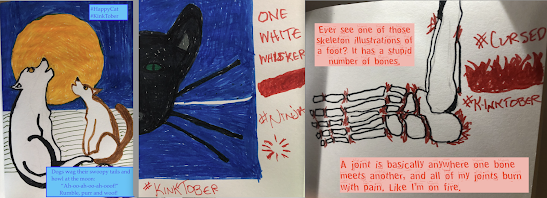
When October rolled around, I did my own version of Inktober (a global art challenge that many illustrators participate in annually). I called it “K-Inktober” and mostly drew “fan art” from my own work, including my published novel, Cursed, and several other

manuscripts and WIPs. 


Three crude drawings. Two dogs howling at the moon; half of a black cat's face with three black whiskers and one white; a skeleton of the foot, drawn in black with red "fire" around each joint. Text includes excerpts from stories and "#KinkTober"
A selection of my favorite drawings from #K-Inktober.

A self-portrait drawing: Karol in the foreground with many drawings on the wall in the background. Text: "I did it!"
Final K-Intober drawing.


Again, the results were mixed, but at the end of the month, I had done 31 drawings! 

What a sense of accomplishment—especially considering I can’t draw.


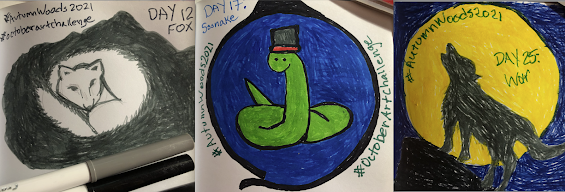
When October 2021 rolled around…I did it again. Jenn Reese and another artist sponsored the #AutumWoods2021 challenge. I had a blast—not only doing the drawings, but sharing them on social media and being a part of the community doing the challenge. 


Three drawings done with markers: an arctic fox; a snake with a top hat in a blue circle; a wolf howling within a large; text for each:"#AutumnWoods2021" and "#OctoberArtChallenge."
A selection of my favorite #AutumnWoods2021 drawings.


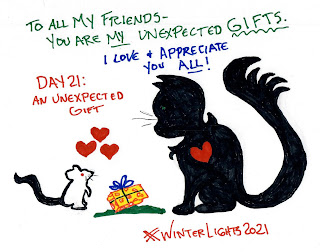
Jenn and two additional artists created a shorter challenge for December, #WinterLights2021. Naturally, badly drawn wild horses couldn’t keep from participating. Since it was only seven drawings this time, I challenged myself to include text with each one. (After all, I’m supposed to be a writer.) That resulted in a couple poems, a scene of dialog between a tree and a wishing star and my first ever attempt at a comic strip!


Turns out—I can draw. I will never rise to a professional level, will never illustrate my own picture book, and no one will ever pay me for my artwork. And that’s absolutely fine. 


Just as I sing for my own pleasure, I’m now drawing for fun and to open myself up as a creative artist and as a human being.

Drawing (in markers) of a mouse and cat. The cat has given the mouse a gift of cheese. Red hearts are above the cheese, which has a ribbon. Text: "DAY 21: An Unexpected Gift, #WinterLights2021" and "You are all my unexpected gifts. I love & appreciate you ALL."
My final #WinterLights2021 drawing.

Many friends commented on  my posts during these art challenges, loving what I was doing but lamenting that they, themselves, can’t draw. So let me pass on to you what I said to them—try it! 


Search the hashtags above or Google “drawing prompts” for ideas. There’s no rule that you have to do art challenges at specific times. You’re also not required to share your drawings (but be my guest and share in the comment section if you feel so motivated).


At the very least, you’ll have fun. At most, you might bring about an incredible shift in your artistic life.


Three cheers for blissful mediocrity!


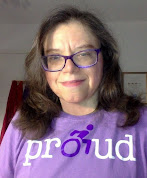
Author photo of Karol Ruth Silverstein wearing a disability pride t-shirt.
KAROL RUTH SILVERSTEIN (she/her/disabled) is a screenwriter and writer of various genres of children’s books. Originally from Philadelphia, Karol now lives in West Hollywood with her incredibly fluffy cats, Ninja and Boo.


Follow her on Twitter @KRSilverstein, Instagram @KRSilverstin2019 and Facebook AuthorKarolRuthSilverstein.


For interviews, author videos, disability-related articles, upcoming events, etc. go to www.karolruthsilverstein.com