Showing posts with label Cursed. Show all posts

Thursday, April 24, 2025

Are Disability Stories in Kid Lit (Finally) Having a Moment?

Looking back at the books I read last year and loved, I was pleasantly surprised to find so much disability representation. True, I do tend to seek out these books, but it definitely seemed like there were a lot available to reach for. The titles that blew me away were also predominantly written by authors writing, at least in part, from their own lived experience. Sweet!


CURSED book cover.
As recently as six years ago, when my own based-on-lived-experience debut YA Cursed came out, there were not as many disability-themed kid lit titles to choose from. The titles that were available were largely written by and featuring cis/het white folks and often weren’t written by authors who identify as disabled or neurodivergent. Both of those statistics are beginning to change—but very slowly. Still, it’s great to see progress happening.

Interested in reading more #DisLit? Here’s bit about the books I’ve read recently and recommend to get you started:


Published in 2024

  • The five book covers mentioned in the text on a dark green background
    2024 was a BANNER year for disability rep in kid lit!
    Joined at the Joints by Marissa Eller. A swoony romance featuring a main character with juvenile arthritis and anxiety. 
  • Chronically Delores by May Van Wagenen (2025 Schneider Family Book Award winner). Delores, who has  interstitial cystitis, launches a mutually beneficial partnership with new autistic friend Terpsichore, from which both teens hope to benefit.
  • Light Enough to Float by Lauren Seal (2025 Schneider Family Book Award honor book). Painfully real depiction of living with anorexia, told in verse.
  • Bitsy Bat, School Star by Kaz Windness. Described as “from an autistic perspective” by the autistic author, Bitsy finds school way too stimulating for comfort but nevertheless finds a way to shine.
  • Next Level: A Hymn in Gratitude for Neurodiversity written by Samara Cole Doyon and illustrated by Kaylani Juanita. A joyful book that invites readers to “level up” and witness our shared humanity.

Published in other years but read by me in 2024:


  • The five book covers mentioned in the text on a dark purple background
    GREAT disability rep! GREAT reads!
    Good Different by Meg Eden Kuyatt  (2024 Schneider Family Book Award honor book). A novel-in-verse about a neurodivergent girl who comes to understand and celebrate her differences. (2023)
  • No Matter the Distance by Cindy Baldwin. A novel-in-verse about a kid with cystic fibrosis who forms a special bond with an ill dolphin. (2023)
  • Aniana del Mar Jumps In by Jasminne Mendez (2024 Pura Belpré Honor book), a novel-in-verse about a 12-year-old Dominican American swimmer who is diagnosed with Juvenile Arthritis. (2023)
  • How it Feels to Float by Helena Fox. One of the most illuminating and empathetic depictions of schizophrenia I’ve ever encountered. (2019)
  • Lover Birds by Leanne Egan—a sapphic enemies-to-lovers story set in Liverpool featuring a powerful portrayal of ADHD. (2025)

Note: You may have noticed a lot of novels-in-verse in the list above. Not only do I love the form, but my current work-in-progress is a verse novel. 


Wish me luck—and happy reading!


Karol Ruth Silverstein's author photo. She's a white woman with wavy brown hair, wearing blue glasses and a lavender top emblazoned with the word "PROUD." The "O" on proud is a dynamic wheelchair icon.


KAROL RUTH SILVERSTEIN is an award-winning children's book author and disability activist. She lives in West Hollywood, CA with two impossibly fluffy cats. 

Thursday, January 27, 2022

Managing Missteps…Oh My!

I have a confession: I read reviews. I know I shouldn’t. I’ve been strongly advised against doing so, but at a certain point I made the decision that, for me, the thrill of a good review outweighed the sting of a bad one. 


A scale with excerpts from good reviews on one side and bad on the other showing the good outweighing the bad.
Particularly thrilling are the “good reviews” where readers with disabilities and chronic illnesses say that my book makes them feel seen and represented in ways they rarely do, thereby letting me know that my aspiration to lift up my community and tell our stories authentically is on track. 


That’s why it’s so uncomfortable when I’m made aware of a misstep. 


Since its publication, I’ve learned that my novel Cursed has a level of ableism that doesn’t sit well with some readers. There was some ableism I wasn’t even aware of. For example, I’d used the words “crazy” and “insane” throughout the book, only learning after the fact that doing so perpetuates the stigma around mental health conditions. Charlesbridge Teen offered to swap out those words in the Cursed paperback, for which I was incredibly grateful.


Conversely, I’d made a conscious decision to include a good bit of internalized ableism in the story. My main character Ricky was able-bodied for the first 13 years of her life, as was I. Thus, following her chronic illness diagnosis, she had to deal with a lot of internalized ableism. I thought it was important to show her growth through and beyond that. 


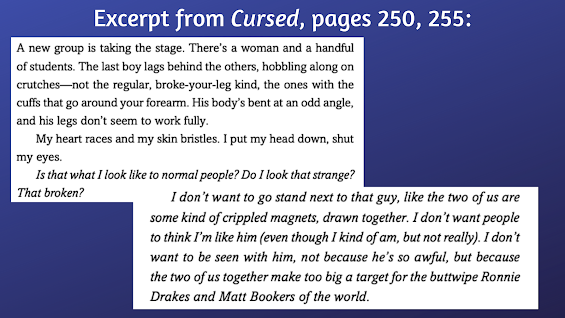
I struggled with one scene in particular where her journey comes to somewhat of a head. Ricky eventually course-corrects her ableist assumptions, but as I was editing, I wondered: Does this go too far? 


Excerpt from the novel, Cursed. Text reads: "I realize I missed a whole school while my head was spinning. A new group is taking the stage. There’s a woman and a handful of students. The last boy lags behind the others, hobbling along on crutches—not the regular, broke-your-leg kind, the ones with the cuffs that go around your forearm. His body’s bent at an odd angle, and his legs don’t seem to work fully.  My heart races and my skin bristles. I put my head down, shut my eyes.  Is that what I look like to normal people? Do I look that strange? That broken?  I don’t want to go stand next to that guy, like the two of us are some kind of crippled magnets, drawn together. I don’t want people to think I’m like him (even though I kind of am, but not really). I don’t want to be seen with him, not because he’s so awful, but because the two of us together make too big a target for the buttwipe Ronnie Drakes and Matt Bookers of the world."


I asked a disabled friend to read the scene, and he thought I was okay. In retrospect, I realized that the friend I’d asked has incredibly thick skin. Maybe I should have consulted additional readers, particularly teens? Maybe I should have taken my own discomfort with the scene as an indication that I should tone it down a tad?


But I didn’t do any of that.


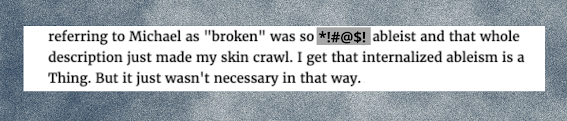
And a recent GoodReads reviewer let me know that, in his eyes, I’d messed up. 


Excerpt reads: "referring to Michael as 'broken' was so *!#@$! ableist and that whole description just made my skin crawl. I get that internalized ableism is a Thing. But it just wasn't necessary in that way."
Excerpt from the GoodReads review. 


Ouch. For me—but more importantly, for him.


The review itself was generous, 4 out of 5 stars, with the reviewer noting that he has cerebral palsy and saying I’d really gotten the “living with chronic pain” experience right. 


Ultimately, I stand by the scene, while also accepting that I let this reader down—someone thrilled to see himself accurately reflected, finally...only to get what felt like a slap in the face later on in the book.


The moral of this awkward story is that—whether we’re intentionally pushing boundaries in an attempt to make a point or unknowingly using harmful stereotypes and insensitive language when we really should have known better—none of this stuff is easy.


I do my best. That’s all any of us can do.


My thanks to Lee Wind for inviting me to share some of my thoughts here on the Official SCBWI Blog this month.


Happy creating everyone!


Photo of author Karol Ruth Silverstein wearing a light purple disability pride t-shirt.
KAROL RUTH SILVERSTEIN (she/her/disabled) is a screenwriter and writer of various genres of children’s books. Originally from Philadelphia, Karol now lives in West Hollywood with her incredibly fluffy cats, Ninja and Boo.

Follow her on Twitter @KRSilverstein, 

Instagram @KRSilverstin2019 and 

Facebook AuthorKarolRuthSilverstein.


For interviews, author videos, disability-related articles, upcoming events, etc. go to www.karolruthsilverstein.com

Thursday, June 20, 2019

Debut YA Author Karol Ruth Silverstein On How Volunteering for SCBWI Led To Her #OwnVoices Breakthrough

SCBWI Volunteer Karol Ruth Silverstein's debut YA novel is called "Cursed" (June 25, Charlesbridge Teen).

Karol sporting her Disability Pride in a t-shirt she designed!


I interviewed Karol to find out more...

Lee: Hi Karol! So please tell us, how did volunteering for SCBWI lead to your getting a book deal?

Karol: Actually Lee, I have you to thank! My journey really started when you invited me to become a coordinator for the Westside Writers Schmooze (now called the Westside Writers Mingle) here in Los Angeles. For any readers who aren't familiar with the Mingles (or LitMingles), they are monthly meetings held by many local SCBWI regions where writers and/or illustrators get together to discuss topics related to children’s books. I ended up coordinating with fellow SCBWI-L.A. member Charlie Cohen for four years. Toward the end of our "reign," I was prepping for a Schmooze on social media for writers. Though I'd had a Twitter handle for a while, I barely used it. Twitter seemed so confusing! I went onto Twitter determined to familiarize myself with the various things one can do on the platform. I spent some time tweeting, retweeting and commenting, and then I decided to follow a few hashtags. I happened to stumble onto the last 15 minutes of a Twitter pitch event (#PitMad)--just enough time to get out a few pitches. Literary agent Jen Linnan “liked” one of my tweets, which meant she wanted to read my manuscript. Long story short, she signed me! (I think it would be responsible of me to add a disclaimer here: results not typical!)

Though my debut YA novel Cursed wasn't the book I'd pitched in the Twitter event, Jen read an excerpt and loved it. She helped me fine tune the manuscript before we went out on submission and we eventually found it a home with Charlesbridge Teen. Cursed was not necessarily an easy sale and I was extremely lucky to find an agent who fell in love with it. I was in the right (virtual) place at the right time. And I was there specifically due to my SCBWI volunteer gig.

Karol's debut YA comes out on June 25, 2019

Lee: Wow, what a story! Why do you say Cursed wasn’t an “easy” sale?

Karol: The easy/most direct answer is that the manuscript had a lot of profanity in it. Like - A LOT. Plus, my main character was originally 13 (though she's now been aged up to 14 to put the book more squarely into the YA category). The cursing is an integral part of the story, so it wasn't like I could cut it all out. The protagonist, Ricky, is newly diagnosed with a painful chronic illness and cursing is one of her main coping mechanisms. As she adjusts to her new reality, she does learn better ways of handling her anger and curses less. But it was important that she be able to fully and realistically vent her frustrations, anger, and fear at the beginning of the book. That meant real cursing—f-bombs and all. Using "darn" and "heck" was not going to cut it in terms of authenticity, which was tremendously important to me.

Cursed is also what some refer to as "younger YA" - for readers aged 12-15 or so. This can be a somewhat tough market in general. Publishers Weekly had an article a while back explaining that, while readers in this age range are underserved and definitely in need of great reading options, agents aren't always sure how to pitch these books, publishers struggle to market them, and booksellers aren't clear where to shelve them. So that added to the challenge.

Lastly, Cursed is about a teen with a chronic illness who experiences chronic pain. Despite the incredibly valuable push for all kinds of diversity in kids books over the last decade, books featuring physical disability and/or chronic medical issues are still not exactly abundant on bookshelves. My editor Monica Perez said that she noticed a lack of these kinds of books in YA in particular, and that was one of the things that drew her to Cursed. The fact that the book is #ownvoices was icing on the cake.

Lee: #Ownvoices of course leads to the question: How much of Ricky’s story is your story?

Karol: I'm glad you asked! While Cursed is very much drawn from my personal experience, it's definitely fiction. People who know me sometimes get confused on that front, I think because Ricky's voice is so similar to mine. The set-up of the story mirrors my life the most: Ricky is sent to live with her dentist dad at his ill-equipped one bedroom apartment (which she dubs the Batch Pad), as a way to make things easier on her physically. Getting to school is still really painful though. Since her dad leaves for work before she needs to leave for school, she realizes she can just pretend she's getting ready for school—and then go back to bed once her dad's gone. She ends up cutting six weeks of school before her truancy is discovered. Basically ALL of that is taken from my life—other than the snarky name for her dad's apartment. Most of what follows in the story is made up, but there are moments, emotions, lessons learned, etc. that are drawn from my experiences throughout my lifetime of living with a chronic illness and figuring out how to partner with medical professionals and advocate for myself.

I remember fabulous YA author Sonya Sones (who blurbed Cursed!) once saying that one of the great things about writing YA is that you can have your characters make the same mistakes you made but figure out better solutions and/or end up making better choices than you did. You can clean up your past and hopefully provide more agency for your teen readers. I condensed a lot of what I've learned about living a life like mine with some modicum of grace into the six month timeframe of the book. Hopefully the book can speed up the process for readers who are dealing with similar circumstances (which I feel can be broadened to include any situation that hinders self-acceptance).

Lee: As a writer with a disability, what do you think the industry can/should do to be more inclusive, equitable, and accessible?

Karol: One of the toughest parts of disability advocacy is how incredibly varied the folks huddled under the disability umbrella are. There simply is no singular way to address the needs, preferences, experiences and sensibilities of all people living with disabilities. Likewise, stories featuring disabled characters are going to be—or should be—of every stripe and color. I think for too long, the narrative for disabled characters has been sorely limited. That's thankfully beginning to change, with #ownvoices disability books—where the author has the same disability or medical condition as the book's protagonist—really moving the needle in terms of authenticity and variety.

The kid lit industry has been a frontrunner in the charge for more inclusion and representation of underrepresented groups, both on the page and "behind the pen." Amazing progress has been made. Still, disability isn't nearly as present in the diversity discussion as some other groups, with physical disability garnering less attention than neurodiversity (a blanket term referring to variations in the human brain). But—as I've seen in a snarky meme—inclusion isn't pie! There aren't a limited number of slices. The We Need Diverse Books website gives an incredibly far-reaching definition of disability and I encourage all people involved in the children's literature industry to check it out and keep it in mind whenever discussions of diversity come up.

Lee: For readers, here's that We Need Diverse Book's definition of diversity:
We Need Diverse Books: Our definition of diversity: We recognize all diverse experiences, including (but not limited to) LGBTQIA, Native, people of color, gender diversity, people with disabilities*, and ethnic, cultural, and religious minorities.

*We subscribe to a broad definition of disability, which includes but is not limited to physical, sensory, cognitive, intellectual, or developmental disabilities, chronic conditions, and mental illnesses (this may also include addiction). Furthermore, we subscribe to a social model of disability, which presents disability as created by barriers in the social environment, due to lack of equal access, stereotyping, and other forms of marginalization.
Okay, Karol, that totally makes me want to ask: can you shout out to some great disability books out there?

Karol: Interestingly, three that come to mind immediately all feature deaf characters - Cece Bell 's terrific #ownvoices graphic novel memoir, El Deafo; the amazing Wonderstruck by Brian Selznick and 2018 Schneider Family Book Award winner, You're Welcome, Universe by Whitney Gardner.

The Schneider Family Book Award is among the awards given annually by the ALA and honors books that embody the artistic expression of disability experiences for child and adolescent audiences. Their list of previous winners is a great place to start for anyone looking to learn and read more about disability, as is the website Disability in Kidlit.

I can also report that there are a number of 2019 debut novelists who've written books featuring characters with disabilities. This is definitely heartening! In particular, YA fantasy We Rule the Night by Claire Eliza Bartlett completely blew me away. The book features a protagonist who's an amputee--and also training to be a fighter pilot. Bartlett handles the character beautifully and the whole book is an incredible thrill ride!

Lee: Any plans to write more books featuring characters with disabilities?

Karol: Yes actually! I'm in the early stages of a young middle grade novel that has a feline main character. But the human main character is young girl who uses a wheelchair. There's also another cat character who's been declawed--which many people don't realize is akin to amputation. This book is not #ownvoices because I'm not a regular wheelchair-user myself (or an amputee), but I liked the idea of including these characters because they exist in the world and should exist in books too! While the disabilities aren't a main focus in the story, they do resonate within the book's themes.

Lee: Thank you so much Karol! And congratulations on your debut!

You can find out more about Karol Ruth Silverstein and "Cursed" at her website here.

Illustrate and Write On,
Lee