| Justin Campbell (left) and Lee Wind (right) create two sides of a heart, symbolizing the friendship, love and joy between us as Lee passes the blogging role on to me. |
Tuesday, July 1, 2025
Justin Campbell & Lee Wind: Baton Pass Interview, Part 2
Tuesday, June 24, 2025
Lee Wind & Justin Campbell: Baton Pass Interview, Part 1
The moment has arrived! After 14 and a half years of blogging for SCBWI, I'll be passing the blogging baton to the wonderful Justin Campbell who starts next week!
![]() |
| Through the magic of online video conferencing, Justin Campbell (left) and me (Lee Wind, at right) make a heart. The perfect metaphor for passing the SCBWI blogging role from me to him! |
Justin and I chatted about how a fun way to finale me and debut him as official SCBWI blogger would be a pair of interviews... And so, today are my answers to Justin's questions.
On Tuesday July 1, Justin will answer my questions, and then this blog and the official blogging duties for SCBWI will be in his capable hands! Here we go...
Justin: How did you initially get involved in KidLit and SCBWI: The Blog?
Lee: I started my own blog (I'm Here. I'm Queer. What the Hell Do I Read?) in September 2007 with a focus on the books for kids and teens that included queer characters and themes. I found myself writing about general KidLit publishing things as I learned the business, including doing interviews with agents and editors.
Alice Pope started SCBWI: The Blog in May 2010 (you can read her first post here), and when she formed the very first SCBWI Team Blog to report on the 2009 Summer Conference in Los Angeles, I was invited to be part of that team (along with Paula Yoo, Jaime Temairik, Jolie Stekly, and Suzanne Young - see us at work here. Wow, was I younger!)
When Alice left KidLit for another industry in October of 2011, I was asked to take over the official blogging duties for SCBWI, which I was thrilled to do! (My very first SCBWI: The Blog post as the official blogger is here.)
It's been an honor, a privilege, and a joy to blog for SCBWI for so many years. I'm especially happy about having shared the spotlight with so many amazing guest bloggers, and extra delighted that you're taking over, Justin!
Justin: What are you looking forward to post-baton pass?
Lee: More time to write! I was pre-published when I started blogging for SCBWI, and I just had my 7th book come out (the picture book Like That Eleanor, illustrated by Kelly Mangan, published by Cardinal Rule Press.)
My 8th book comes out in November (the picture book Banana Menorah, illustrated by Karl West, published by Apples and Honey Press/Behrman House.)
With a full-time job, I don't often get more than an hour a day to write (and sometimes it's just 12 minutes.) I'm excited to take the time I've used for SCBWI blogging and put it into writing (though I expect some of the time will go into the author-promotion-marketing bucket, too.)
Justin: What will you miss the most?
Lee: I really like being helpful and sharing information, resources, and inspiration about KidLit. I'll be doing a monthly newsletter as an author, and I expect I'll share some of that there. (Folks reading this are welcome to sign up here.)
Otherwise, I was going to say I'll miss getting to be at the big SCBWI conferences (especially in-person in New York City) -- but happily I'll still be attending those as an attendee rather than a blogger, and continuing to host the LGBTQ+ and Allies socials as well. Yay!
So really, Justin, I'm passing the baton to you with joy. You're going to do great!
**
For everyone reading, thank you for coming along with me on the adventure so far, and please continue to support and read the SCBWI blog.
I can't wait to see what Justin (and the new guest bloggers) do!
Illustrate, Translate, and Write On,
Lee
Tuesday, June 3, 2025
7 Books in 21 Years: Lee's Tips on Your KidLit Career and Book Promotion
Hello Kid Lit community!
After 14.5 years of blogging for SCBWI, it's my final month as your official blogger. I'm so excited to be passing the baton on July 1, 2025 to Justin Campbell... and that's going to be to focus of my final post, on June 24.
Today (Jun 3, 2025) is also the publication day for my seventh book, the picture book: Like THAT Eleanor: The Amazing Power of Being an Ally, illustrated by Kelly Mangan and published by Cardinal Rule Press.
I started my 'wanting-to-be-published-in-kidlit-and-joining-SCBWI' journey 21 years ago!
All this has put me in a contemplative place. I've had a lot of hard work, downs, and ups on the journey, and thought it might be helpful to share 21 things I've learned so far.
Starting today and for the next two weeks, I'll be sharing 7 tips each week. This week's tips are on your Kid Lit Career and Book Promotion – things I wish I'd known back when I was starting out, and that I'm happy to pass along to you now.
With no further ado,
1) Get/keep a day job.
This one's really hard to admit. For YEARS I imagined getting an agent would lead instantly to an enormously lucrative book deal which would lead instantly to having a huge best-seller and I wouldn't need a day job... Even typing that sentence made sigh out loud.
It's a hard reality, because the people who get up on the stages at the big KidLit events have sort of won the lottery already with their books. They've had the big movies made, they've won the huge awards, and maybe they don't need day jobs.
But the truth of most KidLit creators is that they have a second stream of income beyond their books. Maybe they teach. Maybe they do school visits. Maybe they married someone who's willing and able to support them. Or maybe, like me, they work at a day job. That's okay. There's no shame in it.
As Elizabeth Gilbert says in "Big Magic," demanding your creativity pay the bills is not a very kind thing to do to your creativity.
So what I say to my husband now, every time I have a new book published, is: "Hey, honey! We have another lottery ticket."
2) Be able to elevator pitch your book.
It's going to happen again and again. Someone (usually well-meaning) is going to ask, what's your work-in-progress about? What's your book that's going to be published about? You have a book out -- what's it about?
There's lots of good advice on pitching, much of it published here and on the SCBWI conference blog, but as Eddie Gamarra advises, it should include the when, where, your main character, their goal, and the obstacle to their goal... tone and genre help, too.
As I mentioned above, my new picture book releases today. What's "Like THAT Eleanor" about?
Named by her two dads after Eleanor Roosevelt, Eleanor sees unfair things happen at her school but doesn't know how to help. The real stories her dads share about Eleanor Roosevelt being an ally inspire child Eleanor to stand up for a nonbinary classmate, making their class—and the world—a bit more fair.
3) Bookstores are hard places to sell books.
This one's kind of counter-intuitive, but as much as I love independent bookstores, it's a hard thing for your book to do well in a brick-and-mortar bookstore. Consider that bookstores want to know that a) someone's going to walk in off the street and ask for your book by name; b) someone on their staff is going to be so excited about your book that they're going to hand-sell it to the next person who walks into the store; c) something about your cover, title, subject is so compelling they're going to shelve the book face-out and it's going to sell itself.
The more of those three things you have, the better chance the store's going to risk bringing in your book to their store. Every inch of shelf space has to help them pay rent. And if they bring in your book and it doesn't sell, that's bad for everyone – the store, who then returns the copy to the distributor, the publisher, who loses the sale and has to pay the shipping charges, and you the creator, who doesn't get that royalty after all.
Bookstores are super-important, because they're taste-makers, but most indie publishers do not sell more than 10% of their books in physical bookstores. That's helpful to know.
The best way to pursue bookstore sales is to build a relationship with your local independent bookstore. Buy your books there, and they'll hopefully be excited to carry your books. Maybe you can arrange with them to offer signed copies of your books, as a special promotion to drive customers to them.
It's what I've done with Pages: A Bookstore in Manhattan Beach, California. (You can order a signed copy of Like THAT Eleanor from them here. Just add your request for personalization and a signed copy in the order notes.)
4) Events are for you. They're not about book sales.
Try not to obsess about how many people were there (if you can avoid this, please teach me how). Try not to obsess over how many books you've sold, or you haven't sold (Ditto.)
Even if you have a wildly successful in-person event and you sold 100 copies, that would be amazing, but 100 copies isn't moving the needle unless you can replicate it time after time after time. Maybe once you have a best-seller and are a household name, you can do this, but after your debut book release? Well, I've found it hard to motivate folks to cross town for book 5 or 6 or 7...
Having said that, if an event is for YOU, and done in a way that makes you feel special and excited, by all means, go for it!
The publisher and I are working with the Eleanor Roosevelt Center to do an event on July 27 at Val-Kill, and I'm going to fly to New York to do that. I'm flying and doing the event for ME, because doing an event with that audience, and getting a tour of where Eleanor Roosevelt lived, sounds incredibly fun.
Will it sell 100 books? I have no idea, but it will create a lot of good will with the folks at the Center (and maybe they'll hand-sell the book in the future), I'll talk about the event online (on my blog, social media, and newsletter), and it will be a celebration, for sure!
5) Keep your eyes on your own mat.
This one's from yoga. There are always going to be accolades your book doesn't get. Lists your book doesn't land on. Awards that someone else's book wins instead of yours.
That's okay.
Someone else's sales, marketing plan, deal... it doesn't really impact you and your creative journey.
All you need are some bragging rights for your book. Happily, Like THAT Eleanor already has three strong trade book reviews:
“This warm picture book provides a primer on allyship.” —Foreword Reviews
"Accessible…heartfelt…empowering.” —Publishers Weekly
”With a critically important social justice message, ‘Like That Eleanor’… is timely, entertaining, and thoroughly 'kid friendly'. Especially and unreservedly recommended…” —Midwest Book Review
And something I keep in mind is that my book isn't in direct competition with other books. When someone finishes a great book, they want to know: what's the next great thing I'm going to read? Maybe it can be my book.
6) Social media can be a powerful tool, but an email list is gold.
The challenge with social media platforms is that you can spend a lot of time and energy building a following and then overnight the platform can change their rules and suddenly you can't reach the people who follow you unless you pay.
This happened to me with Facebook. After years of building a following of over 2,000 people they changed the rules, and suddenly only 12 people were seeing my posts... unless I paid Facebook to show it to more people who already had said they were interested in what I was posting!
That's when I started seriously building my email list. I send out a newsletter about once a month, and it's a list I control. I've built it, and the 2,300+ people on it all want to hear my updates.
Social media can be a way to find new people, and deepen connections with existing folks in my universe, but getting someone on my email list is a way for me to know I can reach them. (Sure, folks can and do unsubscribe, and that's fine. The list is there when they're interested in it. Oh, and you can sign up for the Lee Wind author newsletter, too - just click here.)
7) Community is key.
KidLit Publishing is a challenging craft, business, and career. It's made so much easier by having a cohort of folks who are on the journey with you.
I've been fortunate to have found multiple overlapping communities in KidLit -- friends from the Westside Los Angeles mingle (formerly schmooze); friends from SCBWI Los Angeles; friends from SCBWI conferences; friends from a Highlights Writing the Rainbow course who became my picture book critique group; friends from my day-job with the Independent Book Publishers Association; friends from the Queer KidLit Creators group I host once a month, and friends from being the SCBWI official blogger and leader of SCBWI team Blog...
Find your peeps. Support them. Cheer them on. And hopefully, you'll be fortunate enough for them to support and cheer you on, too.
**
Those are our first seven tips!
Tune in next week for our next seven, all about Creating and Revising.
Until then,
Illustrate, Translate, and Write On,
Lee
Tuesday, March 18, 2025
Should parents be allowed to opt their children out of seeing books that include people who are different than themselves?
At Issue:
In this poignant essay in TIME, Our Books Help Teach LGBTQ Themes in Schools. Should SCOTUS Allow Parents to Opt Out?, children's book authors Sarah and Ian Hoffman explain their perspective on being both the parents of a child who doesn't fit the gender binary's strict two-and-only-two boxes of behavior and the authors of one of the books being challenged in a case about to go the Supreme Court of the United States of America.
They write,
Jacob’s Room to Choose is one of nine children’s picture books named in Mahmoud v. Taylor, a lawsuit filed in Montgomery County, Md., by parents who are upset that their children saw books like ours in their classrooms—books that teach self-acceptance and kindness.
Speaking of the power of representation – how meaningful it is when you have it, how devastating when you don't, Sarah and Ian share:
Allowing families to opt their children out of reading our books hurts the children whose lives and families are reflected in those books. “Opt-out” policies starkly communicate to classrooms of children that behaving decently to all human beings is optional and tells kids who are different that they and their families don’t merit the respect of all their classmates.
Some Thoughts on Creating In the Midst of This:
I'm a Gay man who writes books to empower kids and teens. Many of my books are inspired by Queer history and social justice.
The precedent if SCOTUS allows parents to opt-out of seeing and knowing diverse books exists would be wide-ranging. It's not much of a stretch to envision the subsequent groups whose representation in schools would be denied next...
But diverse readers who need to see themselves reflected in books will still need that representation.
And readers from the dominant culture will still need to have empathy and understand that they share so much with people who on the outside may seem really different from themselves.
And maybe most of all, living in community doesn't mean everyone is the same. Rather than seeing that as something to deny, or tolerate, or even accept, shouldn't we be working toward a world where our differences are celebrated?
That's the world I want my kiddo to live in. It's the world I want to help create. And that's a big part of what drives me creatively.
Illustrate, Translate, and Write On,
Lee
Tuesday, July 9, 2024
Considering Crowdfunding? 12 Tips to Know and Consider
You can listen to the full podcast episode (32 min) here: https://bit.ly/CrowdfundingForAuthorsTips
I'm in the middle of my second crowdfunding campaign, and I've learned some things that I hope can help other authors (and it should work for illustrators and translators, too.)
My first crowdfunding campaign was in 2018 for Queer as a Five-Dollar Bill, a book that I author published, meaning when the campaign was successful I hired a team of people to help me put out the best quality YA novel possible. It was my debut, it worked, and the book went on to win some awards, had thousands of readers who loved it, got on a couple of banned and challenged lists, and overall launched my author career.
My second YA novel, A Different Kind of Brave, was traditionally published (in paperback and as an ebook) in March of 2024, by Duet Books/Interlude Press, an imprint of Chicago Review Press. And I pitched the publisher on the idea of crowdfunding to raise enough funds to donate 350 (or more) paperback copies of the novel to LGBTQIA2+ teens while offering backers a special collector's edition hardcover of the novel. They said yes, so I launched my second crowdfunding campaign on June 20, 2024 and it will end 30 days later on July 20, 2024 at 6:50am Pacific: bit.ly/BRAVEkickstarter
The podcast shares 12 tips, and I'll share the first here:
Tip #1: Don't make it about you.
By making my campaign about the community coming together to empower LGBTQIA2+ teens, talking about the project is easy for me, because the focus is not about helping me as much as it is helping them. So I don't have that uncomfortable self-promotion feeling when I'm talking about the kickstarter campaign, because the goal is to empower the teens I wrote the book for, and the way that happens is the crowdfunding to raise money to buy copies of the book to donate.
There are 11 more tips in the podcast... I hope you'll find it both helpful and empowering!
Illustrate, Translate, and Write On,
Lee
Tuesday, July 2, 2024
My Signing Strategy: Ask a Question. What's Your Signing Strategy?
I'm just back from a wonderful four days at the American Library Association conference in San Diego #alaac24 and I had the amazing opportunity of signing all three of my 2024 titles, my YA novel A Different Kind of Brave (Duet Books/Interlude/Chicago Review Press), my nonfiction for grades 6-12 The Gender Binary Is a Big Lie (Zest/Lerner), and my picture book Love of the Half-Eaten Peach (Reycraft).
It was a thrill to meet and personalize/sign about 200 books for the librarians attending across the three signings, knowing they would help get my books into the hands of the very readers I wrote them for, but I had a challenge: It's pretty hard for me to talk thoughtfully and at the same time:
1) spell the person's name correctly even when I'm copying it from a post-it note or their name badge
2) write my message, and
3) sign my name!
The strategy I've come up with (from paying attention when I've waited in line to get a signed copy of a book from more established children's book creators at events like SCBWI conferences, festivals, and bookstores) is asking the person I'm signing for a question.
Turns out I can listen carefully and simultaneously focus enough on my signing to actually get the job done accurately. It's embarrassing to inscribe the message "The light in me celebrates the light in me" because I'm so focused on sharing from my heart in response to what they just said. Yes, this actually happened during this signing. Sigh. So because I didn't want to cross out the mistake, I wrote after it:
oops! I mean the light in YOU!
and I showed the librarian my flub and said that perhaps we could think about it like the postage stamp where the plane was printed upside-down, and that it might be worth something someday--we both had a good laugh about it!
The person I'm signing a book for thinking about and answering my question gives me time to sign their book the way I want to, with care and heart. Because what I want to say is The light in me celebrates the light in you!
With librarians I generally ask: "Where are you a librarian?"
If the answer is too brief (and I need more time) I follow up with: "What do you like most about being a librarian there?"
When it's a signing after I've spoken, I generally ask if there's something that surprised them about what I shared, or if there's something still resonating for them from the talk/session.
The bonus of asking a question is that I get to learn about them, and the whole experience of my signing their book becomes even more personalized, and hopefully, special.
What signing strategies do you use? (See how I asked a question there? Let me know in comments!)
Illustrate, Translate, and Write On!
Lee
PS - You can learn more about my 2024 books here. Thanks!
Tuesday, April 9, 2024
The Differences Between Middle Grade and Young Adult
This past weekend I had the opportunity to be in dialog with middle grade author Chris Baron at the San Diego Writers Festival, in a session sponsored by Anatasia Zadeik called "Middle Grade vs. YA, What's the Difference?"
Using Chris's most recent middle grade novel The Gray, and my own recently published young adult novel A Different Kind of Brave we covered so many things that come into play, and that are different, between the two age categories, including:
- Character age
- Inner journey
- Outer journey
- Voice (for your characters, as well as the voice of the novel's narration/POV)
- Role of family
- Intensity of opposition your main character faces
- To kiss (or not) – how far do your characters go?
- To curse (or not)
- Reader age/maturity
- Who you're promoting the book to once it's published (parents, teachers, librarians, and in the case of YA teens themselves.)
Some resonating takeaways for me included:
Middle grade are books you might imagine a young person reading with their family.
Young Adult might be more a book a teen would read on their own, so it's more personally theirs. Not that they need to hide it from their family, but books better enjoyed independently.
We also had a fun exercise, challenging attendees to do one-sentence pitch for their middle grade or young adult current manuscript and then do it again but this time for the other age category.
The one-liner pitch for Chris's middle grade The Gray (from the copyright page) is:
Sasha has been bullied at his middle school and his anxiety, which he called the Gray, is growing, so his parents and therapist suggest a summer in the country with his aunt might help him.
Chris's new pitch to make The Gray young adult raised the stakes and the drama, and there was talk about aging the characters up as well.
The one-liner pitch for my young adult A Different Kind of Brave is:
My Gay teen love letter to James Bond movies has two main characters: Nico, living a life of adventure that's pretty terrible, and Sam, who lives a life of privilege and wants to be just like James Bond–when they meet and fall in love, everything changes.
What I learned when I tried to make the pitch for A Different Kind of Brave middle grade was that the whole premise of the book didn't work younger. The opposition was too intense, the whole opening sequence of Nico escaping from a gay reprogramming center and then fleeing on his own down to Peru and then Mexico--none of that felt middle grade. It's a book that had to be young adult.
Finally, we offered some tips to get published, both speaking about working on your craft, finding your community, and Chris spoke eloquently about writing your best book (not someone else's) with these words:
"Be your own breakthrough." —Chris Baron
It was a great discussion, and hopefully these notes can help you with your own middle grade or young adult work in progress.
Illustrate, Translate, and Write On,
Lee
Tuesday, February 27, 2024
On Kindness and the Lenses We Work Through
It's one week from the publication of my fourth book, A Different Kind of Brave.
It's my gay teen love letter to James Bond movies, and a book packed with so many of the story things I loved as a teen—secret identities, cool gadgets, exotic cars, high-stakes adventure, and something I never got as teen: a gay love story. Starring two gay teens. Surrounded by a diverse cast of Queer and allied friends.
My book recently got a couple of really nice trade reviews, and that external validation felt so powerful it scared me. I joked that the starred review was like telling my imposter syndrome to go sit in the corner and shut up.
I joked about it, but then found myself thinking about how negative self-talk isn't something I've completely gotten past.
That, and being on the cusp of this YA novel coming out and finally reaching readers has me thinking a lot about my author journey. After all, I started writing for kids and teens in earnest back in 2004, and this is my first traditionally published YA novel, coming out March 5, 2024.
The math is easy (that's twenty years). The lessons feel more hard-won.
So, with the vision that it might be helpful to share, some thoughts:
We writers (and other creatives) are not always kind to ourselves.
We drive ourselves to produce (write every day!), ignoring the wisdom of the seasons: you cannot only harvest. You need to let crops lay dormant (winter), germinate (spring), grow (summer), and only then can you harvest (fall.) Plants and trees don't skip the resting time of winter, and we skip rest at our peril. That's also called "burnout."
The real world is on fire (as the news constantly tells us), and we are tasked by the publishing industry and ourselves with "rising above the noise" to somehow help our book stand out amid millions of other books. Like our book's box office opening week is the most important thing about it (ooh--you wrote a best-seller?) rather than remembering that the impact of one book on one heart is how the world actually changes. That impact is also what truly makes a book sell, through that age-old chesnut: "word of mouth."
Maybe most insidiously, we often view our work with the wrong lens. Most writers and other creatives have multiple lenses we work though, including:
1) The creative lens, when you're researching and crafting something new: I'm an artist!
2) The editorial lens, when you apply your critical eye to evaluate feedback and revise. It's not everything I wanted it to be, but I can make it better.
3) The critic lens, when you beat yourself up about what you didn't accomplish, and occasionally feel okay about what you wrote. This is the home of my "imposter syndrome," which I have to keep reminding has been told to go sit in a corner and be quiet...
Drafting with your creative lens, and the editorial lens intrudes? That makes writing painful and slow. Insert tortured artist cliche here.
Drafting with your creative lens, and the critic lens gets in the way? Hello writer's block.
So I'm trying to learn. To not demand I produce every day. To allow myself the grace of seasons to my creativity. To do my bit to get the word out, and trust that if I created the best book I can, it will reach readers for whom it's important and meaningful. To use the right lens at the right time. And most of all, to be kind to myself on this adventure.
I hope you will be kind to yourself on your creative journey, too...
Illustrate, Translate, and Write On!Lee
p.s.: You can learn more about my books at my website here: leewind.org
Tuesday, June 27, 2023
60 Seconds in the Banned Books Big Chair... What Would You Say?
I'm just back from the American Library Association 2023 Annual Conference in Chicago, where I had the opportunity to be recorded in the very big chair for Banned Books week (that's happening in the fall, October 1-7, 2023.)
The chair was seriously big. I'm 6 feet 4 inches tall, and my feet didn't even touch the floor!
There was a line of librarians and other conference attendees taking turns recording their videos, and counters filled with banned books (classics and new favorites) for folks to choose from.
I'd signed up for a spot to talk about my nonfiction book for readers age 11 and up, No Way, They Were Gay? (Zest Books/Lerner) as it's gotten challenged and banned and called obscene just for sharing the real history and primary sources about men who loved men, women who loved women, people who loved without regard to gender, and people who lived outside the gender binary, across time and around our world.
"Do you know the passage you're going to read?" I was asked by the volunteer running things after I signed the release form.
"How much time do I have?" I asked - I hadn't seen anyone else's being recorded. It was a fifteen minute time slot, so I was thinking I'd have time to talk about the book and read a few pages.
"Between thirty seconds and one minute would be ideal." The volunteer told me.
One minute.
Sixty seconds.
So I didn't read from my book. I held it up, explained what it was, and spoke from my heart about how it was the kind of book that would have changed my life if I'd read it as a young gay kid... and how I hoped it would be available for young people today and tomorrow to read and be empowered by the real history of Queer people existing throughout time and around our world.
And I added that there's no such thing as a silent ally, and we all need to speak up and out against books being banned. Because books can change hearts. And if we all stand up together, we can change the world for the better.
I invite you to think about what you would say if you had 60 seconds to share about why you're against banning books.
The answer's important, as are you.
Illustrate, Translate, and Write On,
Lee
Friday, June 2, 2023
SCBWI member Lee Wind’s new Queer YA Podcast Bypasses “Don’t Say Gay” Legislation to Empower LGBTQIA2+ Teens – an Interview by Lin Oliver
Sometimes, the people behind the scenes at SCBWI have news. I took the opportunity to talk to Lee Wind, SCBWI’s official blogger, about an initiative he’s launched this June.
Lin: Hi Lee! What’s behind turning your YA audiobook into a podcast?
Lee: Making the audiobook of Queer as a Five-Dollar Bill into a podcast that’s free and available to anyone, anywhere, is a way around the banning of books with LGBTQIA2+ content, and the recent legislation banning any mention of Queer lives and loves from public schools all the way through 12th grade in Florida, and beyond.
With every chapter an episode, QUEER AS A FIVE-DOLLAR BILL: THE PODCAST, will drop thirty-six episodes on five Thursdays in June.
Lin: What do you hope the podcast accomplishes?
If I’d found out that Abraham Lincoln was in love with another man back when I was thirteen, or fifteen, it would have changed my whole life. Growing up gay and closeted, the idea that important people in history were also guys who like-liked other guys might have helped me love myself a little bit more – it certainly would have given me hope.
While I don’t have a time machine to go back and give my books to myself when I most needed them, I can pay it forward. QUEER AS A FIVE-DOLLAR BILL: THE PODCAST is a way to empower the young people who need this today.
Lin: Speak to us about the partnership between Lerner, your traditional publisher for the nonfiction books, and self-publishing your novel QUEER AS A FIVE-DOLLAR BILL.
Lee: Queer as a Five-Dollar Bill is the fictional story of Wyatt, a bullied and closeted teen who triggers a conservative backlash and media firestorm when he reveals the real-world evidence that Abraham Lincoln was gay. I crowd-funded and published the book in 2018, raising enough money to hire a great team to professionally publish the novel and donate over 900 copies to LGBTQIA2+ teens with the help of the nonprofit Brave Trails. The audiobook was brilliantly narrated by Michael Crouch, who also voiced the audiobook of Simon vs. The Homo Sapiens Agenda by Becky Albertalli. Queer as a Five-Dollar Bill won the National Indie Excellence Award for Best Book: LGBTQ For Children & Young Adults and was named a Publishers Weekly Indie Success Story. Kirkus Reviews said, “The premise is a real hook… with real potential to influence and educate, on top of entertaining.”
The evidence that Lincoln was indeed in love with another man is further explored in my award-winning non-fiction book for ages 11 and up, No Way, They Were Gay? Hidden Lives and Secret Loves (Zest Books/Lerner Publishing Group), and with their kind permission, the Lincoln chapter including the primary source letters and analysis is available as a free PDF download from my website, leewind.org
Bonus episodes of the podcast will include me being interviewed by legendary children’s and YA author and poet Lesléa Newman, a new audio recording of the Lincoln chapter from No Way, They Were Gay?, and a sneak peek at the introduction from my upcoming nonfiction title The Gender Binary is a Big Lie (Zest Books/Lerner Publishing Group, April 2024.)
It’s great synergy between the book I published myself and the books I have with Lerner, and I can’t say enough great things about the team there. Special shout-outs to Rachel Zugschwert who’s their marketing genius and my amazing editor Shaina Olmanson.
Lin: What do you have coming out next?
Lee: I’m really excited about a new picture book that will be coming out from Reycraft Books, Love of the Half-Eaten Peach. It’s inspired by a true love story from Queer history… back before China was unified, in the time of Confucius, there was a ruler of the state of Wei, Yuan, Duke Ling of Wei. Yuan loved this guy, Mi Zi Xia. They were walking through an orchard and Zi Xia picked a ripe peach off a tree and started to eat it. It was so delicious he stopped after a few bites and offered the half-eaten peach to Yuan. The Duke made a really big deal about Zi Xia giving up his own joy to share it… Something about that moment captured the imagination of people at that time, and for over 1,000 years, the way they said “gay” in Chinese was “love of the half-eaten peach.”
I took that true story, and did a lyrical, epic fairy-tale take on it. The artwork by Jeiting Chen is breath-taking – I can’t wait for the world to see it, and to learn about this amazing story from our Queer history.
Lin: Happy Pride month!
Lee: Thanks, Lin. Knowing SCBWI is a community that cares about me and my LGBTQIA2+ community means more than I can express. I continue to be grateful for the opportunity to be part of the good work SCBWI does!
**
Lin Oliver is Managing Director of the SCBWI Impact and Legacy Fund, is the co-founder of SCBWI, a New York Times best-selling author of over 65 books for children, and Executive Producer of numerous television series and films for family audiences. She is a prominent advocate for literacy and has served on the Board of the Los Angeles Library Foundation and Advisory Council of Common Sense Media.
Wednesday, January 25, 2023
You Already Know Four People (So the SCBWI Winter 2023 Conference Won't Be So Scary/Unknown/Intimidating)
Conferences can be amazing, but they can also bring up a lot of emotions.
Am I going to be the only one there like me?
Will I feel alone?
Will anyone talk to me?
Is it going to be scary? unknown? intimidating?
Well, it doesn't have to be!
Part of the reason SCBWI has a team of bloggers cover the conferences is to take off that edge of nervousness.
You can check out previous posts on the Official SCBWI Conference Blog to get a taste of what conferences are like.
You can read Jolie's post about first timers, and come to the first-timer socials. And learn more about Jolie and her writing and coaching at her website here.
You can check out Justin's post about the power of community, and finding your peeps at the conference and beyond. And discover Justin's illustrations here.
You can laugh with Jaime as she pitches the Piranha Pit - one of many highlights of the in-person conference to come. And see her illustration and books at Jaime's website here.
And you're welcome to learn more about me, Lee, and my books for kids and teens here.
See? You already know four people going to the New York conference. We hope you'll say “hello!”
Get all the details on the in-person #scbwiNY23 conference here.
Illustrate, Translate, and Write On,
Lee
Tuesday, January 17, 2023
What It's Really Like to Have Your Book Banned as an Author
![]() |
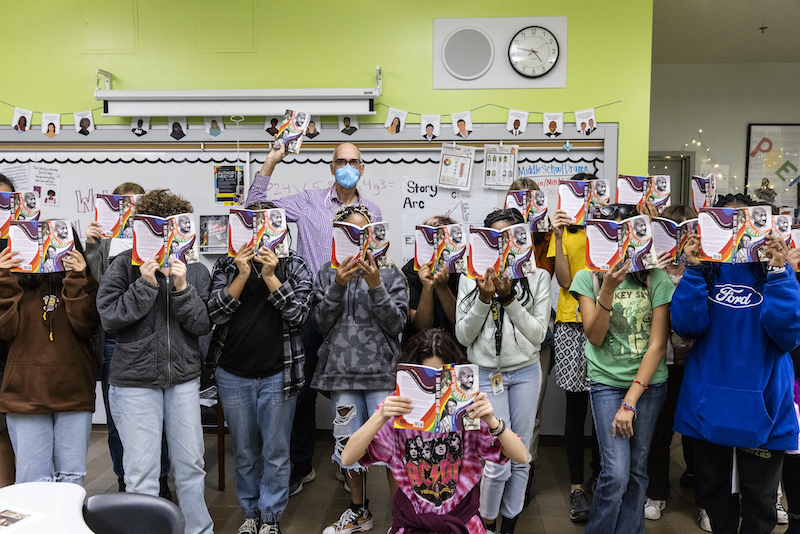
| Highest Highs: Lee and a room full of middle schoolers at a school visit in November 2022, organized by We Need Diverse Books and Writers and Artists Across the Country. Every student in the photo is holding their own copy of Lee's nonfiction book for readers age 11 and up, No Way, They Were Gay? Hidden Lives and Secret Loves. |
I recently fell down the rabbit hole of searching for my book title, “No Way, They Were Gay?” along with the word “ban.” I don’t generally interview the universe for pain, but my nonfiction book for readers age 11 and up was mentioned in the August 2022 BookRiot article that listed 300 books that had been pulled from a Tennessee school district, and then ranked on how Queer their content was.
So for the first time since my book’s publication over a year and a half ago, last month I did that search and suddenly found out that there have been at least three instances where No Way, They Were Gay? was challenged, or banned, or included on a website’s list of books that were “obscene in nature.” It brought up a lot of emotions, which hit me in stages. I thought it might be helpful (for myself and others) to share:
Stage 1:
Relieved: Thank you!
For gosh sakes, there have been lists of over 800 books put out by conservative politicians and no one’s included mine! I felt kind of invisible, like the book I’d poured so much loving care into didn’t matter – even though I know the impact for the good it would have had on me if I’d gotten to read it when I was a kid. So finally, it was like my book was on the radar. Maybe not on the radar of the people it was awesome to be on the radar of, but at least my book was no longer ignored.
Stage 2:
Isolated: Shouldn’t someone have told me?
You kind of imagine there’s some sort of club, and that the moment your book gets banned, you get a membership card in the mail, saying “welcome, we know how shitty this is, and we’re here to help you get through it.” But that didn’t happen. Everyone’s so busy, and there’s so much book banning and challenging to fight. So, even though this is happening to many, many authors, having it happen to me felt kind of isolating. Maybe it’s part of not being in the top ten most banned lists – the rest of us aren’t seeing huge sales bumps, or press coverage. In fact, with the chilling effect these grandstanding bans have, it’s actually hurting sales of books like mine to libraries and schools. Because teachers and librarians now have to consider – is bringing in a book about Queer history worth the personal risk to their careers? Rather than just being able to bring in a book they know will help their students. (These days, 1 in 5 young people are identifying as part of the LGBTQIA2+ community. And while we’re on this subject, knowing Queer people have a history isn’t just helpful to Queer people. Just like knowing women had a role in history is pretty important for those of us who aren’t women to know.)
Stage 3:
Concerned: Is there something wrong with my book?
And then there’s the moment where you question yourself. Is there something dangerous for kids in what I wrote? It was very brief, but there was a moment of worry I experienced. Could my book hurt someone? And as quickly as this emotion rose up, I tossed it away. The whole point of my book is to help, to empower young people to be their authentic selves. It’s not dangerous for kids, it’s dangerous for the world-view of the banners.
Stage 4:
Indignant: What’s obscene is the effort to hide the truth of Queer people’s lives and loves.
A dear friend who has since passed away, Claudia Harrington authored a series of books about kids in kindergarten with different kinds of families. Seeing her My Two Dads and My Two Moms books listed on another banned list along with my book just pissed me off. There’s nothing “obscene” about her very age-appropriate straightforward stories featuring young children with families where the parents are like me – Queer. Those books aren’t about sex, they’re about love being what holds a family together. And similarly, there’s nothing obscene about my using primary sources to explore the lives and loves of 24 notable people in history. The fact that people like Abraham Lincoln may have been in love with another guy isn’t obscene. It’s mind-blowing, yes, but what’s obscene are the ongoing efforts to hide the true stories of men who loved men, women who loved women, people who loved without regard to gender, and people who lived outside gender boundaries.
Stage 5:
Determined: I will not be silenced.
Finding out my book’s been called out in this way – in Texas, in Tennessee, and online, makes me more determined than ever to get it out into the hands of young people for whom it can be truly life-changing. Knowing that Mohandas Gandhi was in love with the German-Jewish Hermann Kallenbach – that the love of his life was another man – may be more than a footnote. It may be an important part of why Gandhi was able to see that, “Let people’s religions be different…. You worship facing one way and I worship facing the other. Why should I become your enemy for that reason? We all belong to the human race…” And Eleanor Roosevelt’s decades-long love affair with Lorena Hickok – another woman – might have been an important part of Eleanor’s determination to lead the passage of the Universal Declaration of Human Rights at the United Nations. And knowing that Hatshepshut ruled over ancient Egypt for 22 years (from 1479-1458 BCE) while transitioning from a female, to an in-between gender, to a male public presentation is incredible. We Queer people have shaped history, and knowing that is important, and empowering.
I want to add a little context: My book came out in April 2021 from Zest Books (an imprint of Lerner) and was a Junior Library Guild Gold Standard selection, got enthusiastic trade reviews, and won a few lovely awards, including being one of the Children’s Book Committee at Bank Street College Best Children’s Books of the Year, The Chicago Public Library’s Best of the Best Books, and it won the International Literacy Association’s best Young Adult nonfiction award.
The three instances I discovered online weren’t the first time “No Way, They Were Gay?” faced opposition – the nonfiction project had originally been sold to an imprint of Simon & Schuster, and I worked with their team for over a year as we prepped for its intended 2017 publication… But then, two weeks after the November 2016 election of former US President Trump, I was informed that they were cancelling publication. (The idea of publishing a book that laid out the evidence that, among other historical surprises, Abraham Lincoln was in love with another man was suddenly terrifying to them.) It was devastating, and cowardly, but eventually the project found the right publishing home with the brave team at Lerner.
Fast forward to the last year and a half of books for kids and teens being challenged and banned in schools, public libraries, and even in one notable case a bookstore, pretty much just for having characters who are Black or Queer. It’s a politicization of empathy – because in a lot of ways, access to knowing about Black or Queer people existing is a train that has left the station. The people banning books can’t pull that information back – most of the kids in their school districts have the internet on their smart phones after all.
Books, though, stay with you – they give you access inside the mind and heart of a character who on the outside may seem so different, and then your shared humanity resonates, and changes how you see the world. Books are empathy machines, and books that include Queer stories threaten the demonization of my community. If we Queer people are seen as human, too, that could disrupt the politics of scapegoating with its long and sad history of success.
Laurie Halse Anderson, whose groundbreaking YA Speak was in the top ten of the ALA’s banned books list for years, very wisely summed it up: “Censorship is most often a reflection of the fears of the censors, their fears that they are not up to the task of having conversations about these hard things.”
And yet, that’s precisely why books are so powerful. They let us experience hard things in the safest way possible. They let us see reflections of ourselves, and others. They let us know we’re not alone. And that fuels me in my passion – to write the books that, had I read them as a young gay kid, would have changed my life. Stories to empower kids and teens to be their authentic selves and change the world. Because I really do believe that’s how we change the world – one book, and one heart, at a time.
***
Lee Wind (he/him) writes stories to empower kids and teens to be their authentic selves and change the world – the same books that would have changed his life as a young gay, Jewish kid. His debut picture book, RED AND GREEN AND BLUE AND WHITE was illustrated by Caldecott Medalist Paul O. Zelinsky and received five starred trade reviews, and The New York Times praised it as “Beautiful… It’s a message the world can use, throughout the year.” He is the author of the nonfiction Junior Library Guild Gold Standard selection NO WAY, THEY WERE GAY? HIDDEN LIVES AND SECRET LOVES and the novel Publishers Weekly named a Top Five Independently Published Young Adult Book of 2018, QUEER AS A FIVE-DOLLAR BILL. He also runs the popular blog I’m Here. I’m Queer. What the Hell Do I Read? – words his teenage self only dreamed of saying. He’s the official blogger for the Society of Children’s Book Writers and Illustrators (SCBWI) and the organizer of the Queer Kid Lit Creators community. Lee lives in Los Angeles with his husband of more than 25 years, and they have a grown daughter. Visit Lee online at leewind.org.
Tuesday, January 12, 2021
SCBWI Celebrates Queer Voices - Thursday January 14, 1pm Pacific (with a 2:30pm Pacific social) on Zoom
SCBWI is launching a new series of FREE digital workshops, "SCBWI Celebrates #OwnVoices," and the first one will be this Thursday January 14, from 1pm-2:30pm Pacific, on Celebrating Queer Voices.
With authors Kalynn Bayron, Mike Curato, Alex Gino, Bill Konigsberg, Abdi Nazemian, and J Yang, and moderated by Phil Bildner, the discussion will cover:
"the joys and challenges of bringing queer representation into their work and the importance of telling the stories they wish they had as a kid."
The session will be held live on Zoom, and will be followed with a safe space social (hosted by me, Lee Wind) for those who identify as part of the Queer community. (That link will be provided during the live workshop.) If you're not able to attend live, the workshop will be recorded and made available by 1pm Friday January 15, 2021.
Here's more on the workshop faculty:
Phil Bildner (moderator) is the award-winning author of numerous books for kids including the 2021 Charlotte Huck Award Honor-winning, A High Five for Glenn Burke and the Margaret Wise Brown Prize-winning picture book, Marvelous Cornelius. He is also the author of the highly acclaimed Rip & Red middle grade series. Phil taught middle school in the New York City Public School system for eleven years and is the founder of The Author Village, an author booking business.
Kalynn Bayron is the bestselling author of the award-winning YA fantasy Cinderella is Dead. She is a classically trained vocalist and when she’s not writing you can find her listening to Ella Fitzgerald on loop, attending the theater, watching scary movies, and spending time with her kids.
Mike Curato is the author and illustrator of everyone’s favorite polka-dotted elephant, Little Elliot. His debut title, Little Elliot, Big City, released in 2014 to critical acclaim, has won several awards, and has been translated into over ten languages. There are now five books in the Little Elliot series, including Little Elliot, Big Family; Little Elliot, Big Fun; Little Elliot, Fall Friends; and Merry Christmas, Little Elliot. Mike had the pleasure of illustrating What If… by Samantha Berger, All the Way to Havana by Margarita Engle, Worm Loves Worm by J.J. Austrian, and contributed to What’s Your Favorite Color? by Eric Carle and Friends and Sunny Day: A Celebration of the Sesame Street Theme Song. His latest books, released in 2020, are The Power of One written by Trudy Ludwig, and his first YA graphic novel, Flamer! Publishers Weekly named Mike a “Fall 2014 Flying Start.” In the same year he won the Society of Illustrators Original Art Show Founder’s Award.
Alex Gino is the author of the middle grade novels Rick, You Don’t Know Everything, Jilly P! and the Stonewall Award-winning George. They love glitter, ice cream, gardening, awe-ful puns, and stories that reflect the diversity and complexity of being alive. For more information, visit alexgino.com.
Bill Konigsberg is the award-winning author of six young adult novels, including Openly Straight and The Music of What Happens. His latest novel, The Bridge, is in development as a limited series at Amazon. In 2018, The National Council of Teachers of English (NCTE)’s Assembly on Literature for Adolescents (ALAN) established the Bill Konigsberg Award for Acts and Activism for Equity and Inclusion through Young Adult Literature. Prior to turning his attention to writing books for teens, Bill was a sportswriter and editor for The Associated Press and ESPN.com.
Abdi Nazemian is the author of three novels. His first, The Walk-In Closet, won the Lambda Literary Award for LGBT Debut Fiction. His most recent, Like a Love Story, an Indie Next Pick, Walden Award finalist and Junior Library Guild Selection, was awarded a Stonewall Honor, and was chosen as one of the best books of the year by Entertainment Weekly, Audible, Buzzfeed, the New York Public Library, and more. His screenwriting credits include the films The Artist’s Wife, The Quiet, and Menendez: Blood Brothers, and the television series The Village and Almost Family. He has been an executive producer and associate producer on numerous films, including Call Me By Your Name, Little Woods, and Scotty and the Secret History of Hollywood. He lives in Los Angeles with his husband and two children.
J Yang is a New York-based illustrator who happens to be a Chinese-American trans man. During quarantine, he has acquired a cherry shrimp hobby, learned a couple of new recipes, and has become a square-shaped grandma in a D&D campaign. You can find his work in Portrait of a Tyrant, Our Rainbow, Spirit Day, and upcoming The Good Hair Day and If You’re A Kid Like Gavin. J is currently at large.
Hope to see you there! (No registration required - just click here for the zoom link.)Tuesday, July 7, 2020
Through The Window: A Discussion about Jewish KidLit and LGBTQ KidLit between Heidi Rabinowitz and Lee Wind
I was honored to partner with Heidi Rabinowitz for this discussion, as part of the Through the Window diversity exchange. Here's the description of that program:
Through the Window is a diversity exchange created by the Association of Jewish Libraries to fight antisemitism and other forms of bias through education and allyship. Jewish organizations swap content with other marginalized communities to give both groups a look through the window at our common humanity.I'm also really delighted that Heidi created an opportunity for us to "use our privilege constructively to boost Black voices," and we've both done so with some recommendations of powerful works by Black creators, which starts the episode off.
Listen to the podcast here, or wherever you listen to podcasts.
If you're curious about the current state of Jewish KidLit, or LGBTQ KidLit, and where these communities (and people and books) overlap and intersect and the allyship that grows from that, it's a great listen.
Illustrate and Write On,
Lee
Tuesday, April 16, 2019
Brendan Reichs and a new metaphor for plotting vs. pantsing
![]() |
| The Los Angeles Times Festival of Books panel (left to right): Brendan Reichs, Ally Condie, Carlos Hernandez, Lee Wind (moderator), and Quinn Sosna-Spear |
A great moment in the middle grade panel I moderated on the YA Stage this Saturday, Middle Grade Fiction: Magic and Mysteries with Quinn Sosna-Spear, Carlos Hernandez, Ally Condie and Brendan Reichs was a question from the audience about process that had everyone on the panel share whether they plotted things out in advance or they wrote by the seat of their pants, making it all up as they went along...
Turned out, Carlos, Quinn, and Ally all mix the approaches, and then Brendan shared that instead of "plotting" and "pantsing," he liked a different metaphor—architects and gardeners. He expanded on the idea, saying that gardeners work with what happens, while architects plan everything out.
And then, it occurred to me that for those of us who combine the two approaches, maybe we're landscape architects?
The idea got a spontaneous wave of applause from the 100+ folks in the audience.
So there you go, another way to describe process... I hope it's helpful.
Illustrate and Write On (no matter your method!),
Lee
Thursday, August 2, 2018
Gearing Up For #LA18SCBWI, Whether You'll Be In L.A. or Following Along Virtually
Visit the SCBWI Official Conference Blog here!
It's here! Tomorrow's the start of the 2018 SCBWI Summer Conference here in Los Angeles, and here's how to both contribute and follow along on social media.
The official hashtag:
#LA18SCBWI
The easiest way to tap into the stream of inspiration, business tips, craft insights, opportunity, and community is to search with the hashtag on your favorite social media platform and find the people posting/tweeting/snapping about #LA18SCBWI... and then follow them, and join in the conversation yourself!
Your #LA18SCBWI Team Bloggers Are:
![]() |
| Martha Brockenbrough |
Martha Brockenbrough is the author of several books for young readers, including Alexander Hamilton, Revolutionary (Feiwel & Friends); The Game of Love and Death; and Love, Santa (both Arthur A. Levine Books). She is a faculty member at Vermont College of Fine Arts Writing for Children & Young Adults program. Forthcoming titles include Unpresidented, a biography of Donald Trump, and Cheerful Chick, a picture book about a resilient bird with a big dream. http://martha-brockenbrough.squarespace.com/
![]() |
| Adria Quiñones |
Adria Quiñones is a wildly successful technical writer who began writing novels for kids in order to have the experience of writing something that someone actually wanted to read. She is a member of Metro-NYC SCBWI's steering committee, hosts the chapter's Upper West Side write/sketch night, and helped found DIALOGS, the chapter's meet-up for kidlit creators from marginalized communities. Adria is a regular contributor to the Metro-NYC SCBWI‘s blog and was a winner of the SCBWI 2014 Midwinter Conference’s prestigious joke contest. In January 2015, Adria was named one of the winners of SCBWI’s Emerging Voices Award for her middle-grade novel, The Disappeared. She is currently at work on a picture book. http://adriaq.com/
![]() |
| Jolie Stekly |
Jolie Stekly is a writer, instructor, and coach. She’s a long-time member of SCBWI and was recognized as SCBWI’s member of the year in 2009. She is a former regional advisor of the SCBWI Western Washington region. Her writing is represented by Rosemary Stimola at Stimola Literary Studio. www.joliestekly.com/
![]() |
| Don Tate |
Don Tate is an award-winning author and the illustrator of numerous critically acclaimed books for children. He is also one of the founding hosts of the blog, The Brown Bookshelf – a blog designed to push awareness of the myriad of African American voices writing for young readers. Don’s books have won the Ezra Jack Keats Book Award, The Christopher Award, a Texas Institute of Letters Literary Award, a Writers’ League of Texas Book Award, and the SCBWI Crystal Kite Award. dontate.com
![]() |
| Jaime Temairik |
Jaime Temairik is originally from Washington State and has recently moved to Philadelphia, PA, where she enjoys finding soft pretzels and colonial-era privy pits. Visit her online illustration portfolio at www.jaimetemairik.com to learn more about her books and work (but not her privy pits).
![]() |
| Lee Wind |
Lee Wind, M.Ed., (and yes, the author of this blog post) is the official blogger for SCBWI (www.scbwi.blogspot.com) and is Captain of SCBWI’s Team Blog. His award-winning personal blog, I’m Here. I’m Queer. What The Hell Do I Read (www.leewind.org) has had over 2.5 million page loads and is a Children's Book Council "Great Diversity Blog." A writer of picture books through YA, his debut crowdfunded teen novel, "Queer as a Five-Dollar Bill," publishes October 2, 2018.
Here's to an amazing #LA18SCBWI ahead!
Thursday, July 6, 2017
#LA17SCBWI Starts Tomorrow! Meet Your SCBWI Team Blog
Check out these interviews with Guest SCBWI Team Blog members Susie Ghahremani here and Sona Charaipotra here.
We'll be live blogging at http://scbwiconference.blogspot.com/ and you can follow along on social media with the hashtag #LA17SCBWI
Here's to wonderful conference!
Illustrate and Write On,
Lee
Tuesday, June 13, 2017
The Diversity Social At #LA17SCBWI
The Diversity Social -- a partnership between We Need Diverse Books and SCBWI -- is another great reason to attend SCBWI's 2017 Summer Conference in Los Angeles, CA, this July 7-10.
Here's Linda Sue Park, Miranda Paul, and Alex Gino, all of whom will attend, with some thoughts to share:
Lee: Why is this so important to you?
Linda Sue: I am on the Board of Advisors for both SCBWI and WNDB. They are the two organizations nearest and dearest to my heart. I firmly believe that together, we're an unstoppable force for helping young readers grow up to save the world.
Alex: Children are learning what's in the world and what to think of it. Kids who are marginalized for their gender, race, religion, disability, language, sexuality, socioeconomic status, and/or family structure deserve to see themselves represented well in literature. And kids with privilege in any of those areas who read diversely are more likely become adults with compassion, which we as humans sorely need more of. I appreciate WNDB's broad vision of diversity, and our approach of addressing the need for increased diversity at every level of the publishing industry, from writers to publishers to booksellers and librarians to readers. And the more good diverse literature is available, the more those readers will turn into writers and publishers and booksellers and librarians.
Miranda: The diversity social is important to me because diversity is an important issue, period. Representation in books is a matter of social justice. Event after event from diversity campaigns lead to connections, and opportunities, and ultimately books that build empathy in our citizens. As a child, I grew up with characters who looked like me, but what about creators who are still overcoming a lack of childhood representation? The creators who will attend this event are making books for my children, who unfortunately don't have the same random chance to see themselves represented as I did. Every event WNDB and SCBWI does can help turn the tide, even if it's only a small amount. The audiences we write for are young and forming their identities. Our literature needs to honor and reflect the lives, stories, and experiences of all young people. Every event that helps to support diverse book creators ultimately helps children be more able to find books that speak to them or open their minds to others' experiences.
Lee: Why it should be important (or should it?) for every creator of content for kids and teens attending the conference?
Linda Sue: The goal is for children's books to accurately include and reflect the glorious diversity of children in this country. Until then, creating, publishing, bookselling, and sharing books will always be fraught with questions of representation and fairness. Only when we reach the point of true inclusion will we ALL be able to create and publish with total freedom. The long game: Creating a diverse landscape in children's literature BENEFITS EVERYONE.
Miranda: I don't think it's important for every creator of content for kids and teens to attend this event. I do think that diverse writers and illustrators, outspoken and considerate allies, and publishing professionals who are looking to acquire more #ownvoices material should definitely come. You're not alone!
Lee: What are your hopes for the social?
Linda Sue: It's my fervent hope that the 'Diversity Social' will be THE gathering to attend at the conference! I hope all such gatherings will grow and grow until they're so inclusive that we won't need them any longer. Every facet of children's literature--creators, readers, teachers, librarians, booksellers, publishers, SCBWI members!--should be as diverse as the world we live in. It's the first step toward the ultimate dream of 'liberty and justice FOR ALL.'
I also hope it will be REALLY REALLY FUN. ;-D
Alex: My hope is that the social will connect burgeoning and unpublished diverse writers and illustrators with information about WNDB and our programs, including our grant and mentorship programs, as well as with authors and illustrators working in the field. I also hope that writers and illustrators interested in learning more about WNDB and possibly getting more involved with what we do will take this opportunity to drop in, meet us, and ask questions about what it's like working with WNDB.
Miranda: I hope the diversity social at SCBWI's Summer conference helps attendees to kickstart new relationships or bolster previous acquaintances. Writing or illustrating books and navigating the publishing industry are not easy feats, but especially so if you're someone who is consistently in the minority at writer's events. Most creators work in isolation, and have questions about craft or business that are best answered or explored through relationships with experienced professionals. But how does one gain access to professionals who might have been through similar experiences or be writing from a similar viewpoint? The idea of gathering like-minded individuals in one room will allow some of those relationships to naturally begin through shared experience, heritage, or identity. SCBWI and WNDB, among many organizations, have been working to change the dismal diversity statistics in children's publishing. We've moved beyond hosting panels stating that we need diversity—we all know and agree. Our initiatives have shifted to taking action. I have no doubt that POCs, writers with disabilities, or those from or focused on underrepresented populations in children's literature will benefit from making connections in this casual setting.
We hope to see you there!
Get all the information about #LA17SCBWI here, and learn more about We Need Diverse Books at their website, here.
Illustrate and Write On,
Lee