Showing posts with label Social Media. Show all posts

Tuesday, June 3, 2025

7 Books in 21 Years: Lee's Tips on Your KidLit Career and Book Promotion

Hello Kid Lit community!

After 14.5 years of blogging for SCBWI, it's my final month as your official blogger. I'm so excited to be passing the baton on July 1, 2025 to Justin Campbell... and that's going to be to focus of my final post, on June 24.

Today (Jun 3, 2025) is also the publication day for my seventh book, the picture book: Like THAT Eleanor: The Amazing Power of Being an Ally, illustrated by Kelly Mangan and published by Cardinal Rule Press.

I started my 'wanting-to-be-published-in-kidlit-and-joining-SCBWI' journey 21 years ago!

All this has put me in a contemplative place. I've had a lot of hard work, downs, and ups on the journey, and thought it might be helpful to share 21 things I've learned so far.

Starting today and for the next two weeks, I'll be sharing 7 tips each week. This week's tips are on your Kid Lit Career and Book Promotion – things I wish I'd known back when I was starting out, and that I'm happy to pass along to you now.

With no further ado, 

Tips from 7 Years in 21 Years: Career and Promotion - a photo of Lee Wind with the covers of his seven kidlit books (and a rainbow)


1) Get/keep a day job.

This one's really hard to admit. For YEARS I imagined getting an agent would lead instantly to an enormously lucrative book deal which would lead instantly to having a huge best-seller and I wouldn't need a day job... Even typing that sentence made sigh out loud.

It's a hard reality, because the people who get up on the stages at the big KidLit events have sort of won the lottery already with their books. They've had the big movies made, they've won the huge awards, and maybe they don't need day jobs.

But the truth of most KidLit creators is that they have a second stream of income beyond their books. Maybe they teach. Maybe they do school visits. Maybe they married someone who's willing and able to support them. Or maybe, like me, they work at a day job. That's okay. There's no shame in it.

As Elizabeth Gilbert says in "Big Magic," demanding your creativity pay the bills is not a very kind thing to do to your creativity.

So what I say to my husband now, every time I have a new book published, is: "Hey, honey! We have another lottery ticket."

2) Be able to elevator pitch your book.

It's going to happen again and again. Someone (usually well-meaning) is going to ask, what's your work-in-progress about? What's your book that's going to be published about? You have a book out -- what's it about?

There's lots of good advice on pitching, much of it published here and on the SCBWI conference blog, but as Eddie Gamarra advises, it should include the when, where, your main character, their goal, and the obstacle to their goal... tone and genre help, too.

As I mentioned above, my new picture book releases today. What's "Like THAT Eleanor" about?

Named by her two dads after Eleanor Roosevelt, Eleanor sees unfair things happen at her school but doesn't know how to help. The real stories her dads share about Eleanor Roosevelt being an ally inspire child Eleanor to stand up for a nonbinary classmate, making their class—and the world—a bit more fair.

3) Bookstores are hard places to sell books.

This one's kind of counter-intuitive, but as much as I love independent bookstores, it's a hard thing for your book to do well in a brick-and-mortar bookstore. Consider that bookstores want to know that a) someone's going to walk in off the street and ask for your book by name; b) someone on their staff is going to be so excited about your book that they're going to hand-sell it to the next person who walks into the store; c) something about your cover, title, subject is so compelling they're going to shelve the book face-out and it's going to sell itself. 

The more of those three things you have, the better chance the store's going to risk bringing in your book to their store. Every inch of shelf space has to help them pay rent. And if they bring in your book and it doesn't sell, that's bad for everyone – the store, who then returns the copy to the distributor, the publisher, who loses the sale and has to pay the shipping charges, and you the creator, who doesn't get that royalty after all. 

Bookstores are super-important, because they're taste-makers, but most indie publishers do not sell more than 10% of their books in physical bookstores. That's helpful to know.

The best way to pursue bookstore sales is to build a relationship with your local independent bookstore. Buy your books there, and they'll hopefully be excited to carry your books. Maybe you can arrange with them to offer signed copies of your books, as a special promotion to drive customers to them.

It's what I've done with Pages: A Bookstore in Manhattan Beach, California. (You can order a signed copy of Like THAT Eleanor from them here. Just add your request for personalization and a signed copy in the order notes.)

4) Events are for you. They're not about book sales.

Try not to obsess about how many people were there (if you can avoid this, please teach me how). Try not to obsess over how many books you've sold, or you haven't sold (Ditto.)

Even if you have a wildly successful in-person event and you sold 100 copies, that would be amazing, but 100 copies isn't moving the needle unless you can replicate it time after time after time. Maybe once you have a best-seller and are a household name, you can do this, but after your debut book release? Well, I've found it hard to motivate folks to cross town for book 5 or 6 or 7... 

Having said that, if an event is for YOU, and done in a way that makes you feel special and excited, by all means, go for it! 

The publisher and I are working with the Eleanor Roosevelt Center to do an event on July 27 at Val-Kill, and I'm going to fly to New York to do that. I'm flying and doing the event for ME, because doing an event with that audience, and getting a tour of where Eleanor Roosevelt lived, sounds incredibly fun.

Will it sell 100 books? I have no idea, but it will create a lot of good will with the folks at the Center (and maybe they'll hand-sell the book in the future), I'll talk about the event online (on my blog, social media, and newsletter), and it will be a celebration, for sure!

5) Keep your eyes on your own mat.

This one's from yoga. There are always going to be accolades your book doesn't get. Lists your book doesn't land on. Awards that someone else's book wins instead of yours.

That's okay.

Someone else's sales, marketing plan, deal... it doesn't really impact you and your creative journey.

All you need are some bragging rights for your book. Happily, Like THAT Eleanor already has three strong trade book reviews:

“This warm picture book provides a primer on allyship.” —Foreword Reviews

"Accessible…heartfelt…empowering.” —Publishers Weekly

”With a critically important social justice message, ‘Like That Eleanor’… is timely, entertaining, and thoroughly 'kid friendly'. Especially and unreservedly recommended…” —Midwest Book Review

Would it be great to get more? Sure. Win a big award? Yeah. But it's okay if other books get other spotlights. I have what I need for this book, in that it's be vetted beyond me and the publisher.

And something I keep in mind is that my book isn't in direct competition with other books. When someone finishes a great book, they want to know: what's the next great thing I'm going to read? Maybe it can be my book.

6) Social media can be a powerful tool, but an email list is gold.

The challenge with social media platforms is that you can spend a lot of time and energy building a following and then overnight the platform can change their rules and suddenly you can't reach the people who follow you unless you pay.

This happened to me with Facebook. After years of building a following of over 2,000 people they changed the rules, and suddenly only 12 people were seeing my posts... unless I paid Facebook to show it to more people who already had said they were interested in what I was posting!

That's when I started seriously building my email list. I send out a newsletter about once a month, and it's a list I control. I've built it, and the 2,300+ people on it all want to hear my updates. 

Social media can be a way to find new people, and deepen connections with existing folks in my universe, but getting someone on my email list is a way for me to know I can reach them. (Sure, folks can and do unsubscribe, and that's fine. The list is there when they're interested in it. Oh, and you can sign up for the Lee Wind author newsletter, too - just click here.)

7) Community is key.

KidLit Publishing is a challenging craft, business, and career. It's made so much easier by having a cohort of folks who are on the journey with you.

I've been fortunate to have found multiple overlapping communities in KidLit -- friends from the Westside Los Angeles mingle (formerly schmooze); friends from SCBWI Los Angeles; friends from SCBWI conferences; friends from a Highlights Writing the Rainbow course who became my picture book critique group; friends from my day-job with the Independent Book Publishers Association; friends from the Queer KidLit Creators group I host once a month, and friends from being the SCBWI official blogger and leader of SCBWI team Blog...

Find your peeps. Support them. Cheer them on. And hopefully, you'll be fortunate enough for them to support and cheer you on, too.

**

Those are our first seven tips!

Tune in next week for our next seven, all about Creating and Revising.

Until then,

Illustrate, Translate, and Write On,
Lee


Tuesday, March 4, 2025

Why Do Authors Use Social Media? Results from a survey of 850+ authors


screenshot of BookBub article "Social Media for Authors in 2025"

The results from this BookBub survey of authors had some interesting points, covering platforms, categories and genres, and much more. And while it wasn't a survey of just kidlit authors, it's worth checking out.

The standout point for me was the “why” authors do social media - “to reach new readers” was the top reason at 79%, but next was “to build relationships with my biggest fans” at 64%. That’s really intriguing…

Personally, I have thought of social media more as a way to reach new readers rather than thinking of it as a way to build relationships with my biggest fans, but maybe that's something I should re-examine. After all, most of the people who engage with my posts on Instagram, Facebook, and Bluesky aren't "new" to me being an author. Maybe they haven't read the latest book, but they know I'm an author...

I'll certainly give this some thought. I hope you'll find this survey's results helpful, too.

Illustrate, Translate, and Write On,
Lee

Tuesday, July 16, 2024

"Break Up With Your X" - Can you do it without hurting your #kidlit career? Brian Kirby has receipts (a.k.a., the stats.)

So I spent years growing a following on Twitter (now X). In the beginning it was really cool, and I could connect with so many other #kidlit folks about our shared enthusiasm, about writing, about inspirations, about a career in children's books...

But about three years ago I left. It felt like an unsafe space, more about heat than light, and made me actively anxious and unhappy every time I logged in. 

I do not believe it's gotten better since becoming X. Most of the conversations I've had about leaving that platform involve some response like "but everyone's there!" and "how can I leave if all the agents and KidLit gatekeepers are still there?"

Since its new ownership and rebranding, there's been quite the exodus from X. And in the last few months, folks have been leaving (or vastly curtailing what they post on) Instagram -- particularly illustrators. The Andrea Brown Literary agency announced on Jun 13:

Due to Meta's AI policies, the ABLA instagrams have been cleared until we can fully assess how best to support and protect our artists and creators here moving forward! In the meantime, head on over to our website and find us on BlueSky.

I'm not an illustrator, and still on Instagram (and Facebook, both of which are owned by Meta), but I have been spending more time on BlueSky (where there are a LOT of illustrators) and it reminds me of those early days on twitter, where you could follow a hashtag and be in a KidLit community not mediated by algorithms. (I basically just look at the KidLit Mega Feed.) 

Back to the numbers... Brian Kirby did this amazing analysis: "Break Up With Your X" looking at what you'd actually be missing if you left X. 

Just one amazing example:

A publishing company has 236,000 followers on X. A recent book announcement post of theirs got zero retweets, 2 likes, and reached 897 accounts.

My favorite line of Brian's analysis:

Posting on X is "getting the sort of response a flyer on a coffee shop bulletin board would get, if soulless robots drank coffee."

Read Brian's full post here.

screenshot of Brian Kirby's "Break Up With Your X" post, showing an illustration of a child dropping a Twitter bird


...so maybe we'll see you on Bluesky! 

(If you're heading over to Bluesky, first thing to do is follow Debbie Ridpath Ohi who is leading our #kidlit community there (Debbie has 21,000 followers on Bluesky. People are there. KidLit people. Brian has been posting about these stats there as well.)

Illustrate, Translate, and Write On,
Lee


Thursday, June 20, 2024

Reasons To Be In More Than One Critique Group

Common advice writers are given when new to the industry is to find a critique group—a group of writers who share their stories and provide each other with feedback to improve them. Some benefits to being a part of a critique group:

  • Your writing skills will improve as you analyze what is working and not working in other stories.
  • You help each other learn about the industry, share the frustrations, and celebrate the good news, both big and small.
  • Having regular meetings with a critique group gives you a deadline to write/revise your stories.


Those are all good reasons to join a critique group. But, if you can, consider joining more than one. I’m in four! Each have different structures and time frames for submitting a story for critique and providing feedback:

  • An in-person group that focuses on picture books and meets once a month.
  • An online group for picture books where two authors submit a story each month.
  • An online nonfiction group for any age group of KidLit—PB to YA—where we take turns submitting stories every two weeks.
  • Another online nonfiction one for just picture books where we can submit one story each month, but we are very sporadic.


Why do I like to be in more than one critique group?

  • As we all know, writing is subjective and so are critiques. And different writers might be better at critiquing different aspects of your story. By submitting the same story to different groups, I get many view points. While various view points may be conflicting, if I see some repeated comments about the same issue, it’s a really strong indication that that part of my story may not be working. And while I may not make every change suggested, the various opinions at least makes me think about things I might not have considered. That is always a good thing.
  • As I noted above, my various critique groups work in different ways for submitting a story for critique and for providing feedback. Depending on the schedule each group has determines when I can send a story for review. Sometimes I have deadlines that I’m trying to meet and my turn for submitting might not coincide with when I need the feedback. Being in more than one group increases my odds of getting the feedback when I need it.
  • Sometimes one critique group has seen a story multiple times. As the saying goes, you only get one time to make a first impression. It can be hard for a critique group to review a story they’ve seen multiple times since they may bring their previous views to the one they are reading. By submitting a story to a different group for the first time, I’m getting a “clean” take on that story.


Other authors have also shared why they like being in more than one critique group:


Kathy Halsey, author of BE A RAINBOW (KiwiCo), is in two groups but also has several critique partners. She states, “Having all these groups gives me different perspectives, a broader view of how my work is seen by others, and a way to keep several stories going at the same time."


Lisa Katzenberger, author of A LOVE LETTER TO MY LIBRARY (Sourcebooks), among others, is also in two critique groups. She says “I love sending the various groups a PB at different stages of revision.”


Lynn Becker, author of JUNE MOON (Familius), states, “ I have two that meet regularly as well as various friends I can usually send work to when I need fresh eyes. It’s especially important for work that needs lots of revisions, when one group has seen something just too many times.”


It can be hard to find one critique group, much less four. How did I find them? 

  • SCBWI regional conferences: I found my in-person group when I joined SCBWI about 15 years ago. Our regional chapter had a list of contact people and critique groups they formed. I reached out to one person who had a picture book group and they had an opening. Another time I was at a different regional conference and connected with a another PB writer. She mentioned her online critique group had an opening and wondered if I would like to join them.
  • The Writing Community: The other two groups came about from writing connections I made, mostly from online groups, like 12x12, in Facebook, or the SCBWI Message Boards.


Tips on finding your own critique group (or two or three):

  • Attend writing conferences/classes both in person and online where you will meet fellow writers. The bonus with connecting with writers from classes you take means that you have similar writing goals or interests.
  • If you are on social media, connect with other writers there. Twitter/X has a hashtag for various writing categories: #kidlit #5amwritersclub #nfforkids, etc. Bluesky also has an active #kidlit group. Sometimes classes you take will form their own group on Facebook. Facebook also has groups like Kidlit411, SubItClub, etc. Kidlit411 has a specific Facebook group for manuscript swaps:  https://www.facebook.com/groups/KIDLIT411MSswap/.
  • The SCBWI Discussion Boards: If you are a registered member with SCBWI, there is a thread called “Find/Join Critique Groups” on the discussion boards. Click here: https://www.scbwidiscussionboards.org/index.php.
  • Inked Voices: Inked Voices is an online group for writers. It has a membership fee but it is a great place to find fellow writers and to dig deep into craft. Once a member, you can find “critique pop-ups” and join critique groups. Plus they offer workshops with agents, editors, and published creators. Learn more here: https://app.inkedvoices.com/.


I’m certain I would not be a published author without the help from my critique groups. I also know that the friends I have made through my critique groups have helped me weather the challenging aspects of the KidLit industry. I’d love to hear your thoughts on critique groups or advice where other writers might find critique partners in the comments of this post.


©Yanka Photography

Debra Kempf Shumaker started reading at the age of four and hasn't stopped since. She grew up on a small dairy farm in Wisconsin but now writes picture books from her home in the suburbs of Northern Virginia. She is the author of FREAKY, FUNKY FISH (2021), TELL SOMEONE (2021), PECULIAR PRIMATES (2022), and the upcoming WIND IS A DANCE (October 1, 2024). 


Debra is a member of SCBWI, several critique groups, and also a co-host of #PBPitch, a Twitter pitch party for picture books. Debra reviews picture books on Instagram every Monday, Wednesday, and Friday, firmly believing there is a picture book for every reason, every season, and every age. Visit her online at www.debrashumaker.com, on Twitter or X at @ShumakerDebra, on Instragram at @debrakshumaker, and Bluesky at @debrakshumaker.


Thursday, May 23, 2024

Social Media Tips that Stand the Test of Time

 Last week, I talked about having a marketing plan and setting goals. This week, I thought I’d talk about social media, since that’s obviously closely linked. I do a talk at writers’ conferences on the subject, and the room is always filled with creatives who are almost afraid of social media. And that can’t be the point.

            The best way to look at social media platforms is this: they are a tool to help you reach individual readers. That’s it. You’re talking to one reader at a time.

You don’t have to dance on Tiktok if that’s not your thing.


1.     Set Social Media Goals

A good place to start is to make a list of social media platforms and see what they do. Facebook is for friends and fans, X (formerly Twitter) is for quick bites of information, Instagram for photos and short videos, Tiktok for spontaneous videos. Think about what you’re comfortable sharing. Readers, librarians and teachers love a behind-the-scenes look at your workspace, your inspiration, and your process.

            If you’re new to social media, set smaller goals until you feel more comfortable. If short form sharing doesn’t speak to you, consider starting a newsletter. Much like this blog, it allows you to write longer pieces and reach readers directly in their email inbox.

            The key is to build a habit and share regularly. That way, your readers and fans know when they can expect to hear from you. Start with weekly goals and a checklist, so you can walk away (and get back to writing!) when you’re done.


This is my virtual author visit setup (complete with ravens)

2.     Create a Social Media Calendar

Using your big-picture goals, set a social media calendar. What are you going to share, and when will you share it? Each platform has a best time to share as well (you can Google this) so plan around that. You can even use a social media scheduling tool.

A word of caution: all these platforms only work if you engage with fans. Comment on and share other people’s posts—it’s called social media for a reason: you must be social.


3.     Focus on Individual Connections & Do Nice Things for Others

If it feels like you’re screaming into a void, you’re probably not approaching social media right. Even if only one person comments or shares your post, that’s okay: you still made a connection. People who have massive followings and engagement tend to be bigger name authors and illustrators, so don’t compare yourself to those people. It takes years to develop this kind of following. It’s better to look at growing your number of followers as a long term goal but not as something you can control.

If you’re unsure of what to do, do something nice for someone else. Post a review, share a new release (called a bookbirthday), and celebrate good news a friend has. It’ll earn you some goodwill points and with some luck, they’ll share your good news when it’s your turn.


Extra tip: try out two platforms if possible. The consensus used to be that you should pick your favorite platform and focus there, but with the recent uncertainty in platforms (Twitter’s demise and transformation into X, Tiktok on the brink of being banned, etc.), don’t put all your social media eggs in one basket. Try to be active on at least two platforms.

You can Google examples of social media calendars, though I urge you to find your own process. Everyone shares in their own way. That’s what makes social media interesting.


How about you? How do you manage your social media?

About Fleur:

Fleur Bradley has loved mysteries ever since she first picked up an Agatha Christie book at the age of eleven. She’s the author of middle-grade mysteries Daybreak on Raven Island and Midnight at the Barclay Hotel (Viking/PRH), the Double Vision trilogy (HarperCollins), as well as numerous short stories, one of which was recently chosen for the annual Best Mystery Stories of the Year anthology. Fleur’s work has been nominated for the Agatha and Anthony Award and has won the Colorado Book Award, among others.

A reluctant reader herself, Fleur is also a literacy advocate and speaks at events on how to reach reluctant readers. Originally from the Netherlands, she now lives in a small cottage in the foothills of the Colorado Rockies.

You can find Fleur online at fleurbradley.com.


Thursday, November 24, 2022

The Hunt for a Twitter Replacement


 The recent acquirement of Twitter by Elon Musk has set off a chain of chaos and uncertainty for the platform, leaving many scrambling for ways to maintain their industry connections and bases online without it. In the past few years, Twitter has become a center for communities in publishing, comics, and other creative fields. It’s been a place for writers and artists to get their work in front of editors and agents outside of conventions, for collaborators to meet, and for creators to share their art. It’s also been home to numerous pitching events, many of which specifically aim to spotlight diverse creators and bring diverse voices into publishing, such as #DVPit, PitMad, #LatinxPitch, and APIpit. The uncertainty in the past few weeks has threatened all of that work and community.

To be clear, it’s unlikely that Twitter is going anywhere in the very near future. Sites like MySpace are still around, despite no longer being the dominant online space, and it’s likely that even if Twitter falls off it’ll continue to persist in some fashion for a while yet. Hopefully that helps relieve some related anxiety!

That said, creators have been looking for alternatives to reconnect and establish bases in the event of a Twitter shutdown. Discord has been used by many long before this to host and join communities. You can join and create private servers with invites from friends, or you can look for and join public servers. You can find some semi-public servers as well, as some professionals in comics and art have created servers to host industry chatter. Some pitching events such as APIpit already have their own discord servers. It doesn’t have the discoverability of Twitter or the equivalent of events, but it can be a good way to keep up with industry friends and share resources.

Tumblr has also seen a resurgence in the uncertainty surrounding Twitter. Tumblr downloads were up as high as 60% last week. Tumblr benefits from being a preexisting website and large social media platform, as well as having a robust tagging system, but it’s historically been a predominantly fandom driven site. There have been writers and artists that have gotten their starts and been discovered on Tumblr in its hey-day, but it remains to be seen if the industry will follow users back as well. 

Two recent contenders that have proposed as Twitter alternatives have been Mastodon and Hive Social. Mastodon is a network of serves that is meant to look and function similar to Twitter. It’s seen hundreds of thousands of users sign up in the last few weeks, but its decentralized format has led to some confusion (users sign up for a single server, but then can interact with other users through Mastodon). There are frequently boosted posts to explain how the app works. 

Hive Social is another app that’s been around since 2019, but has also seen an incredible boost the last few weeks, reaching a million users a few days ago. It’s formatted similarly to Twitter and appears relatively intuitive, but it currently doesn’t have a web app, and has experienced some crashes with its sudden influx of users. 

Only time will tell how Twitter will fare in these coming months, and if any of the proposed alternatives will be able to keep up the momentum and become a social media staple. What is sure, however, is that the publishing industry and community isn’t going anywhere fast.


Cindy Harris (she/they) is a Mexican American comics artist and illustrator that works in the publishing industry. She has worked as a letterer, editor, illustrator, and writer, and loves stories about identity, relationships, and growth.


Thursday, July 21, 2022

Promo Groups 101

Promo group posts seem to be growing on Instagram and Twitter these days. PB Sunrays Book Launchers, Picture Book Scribblers, Picture Book Launch 2022, 22 Debuts, 2023 Debuts, and Class of 2k22 Books are just some of the ones I've seen lately.

But what even is a promo group? Do you need one? And how do you join or start one?

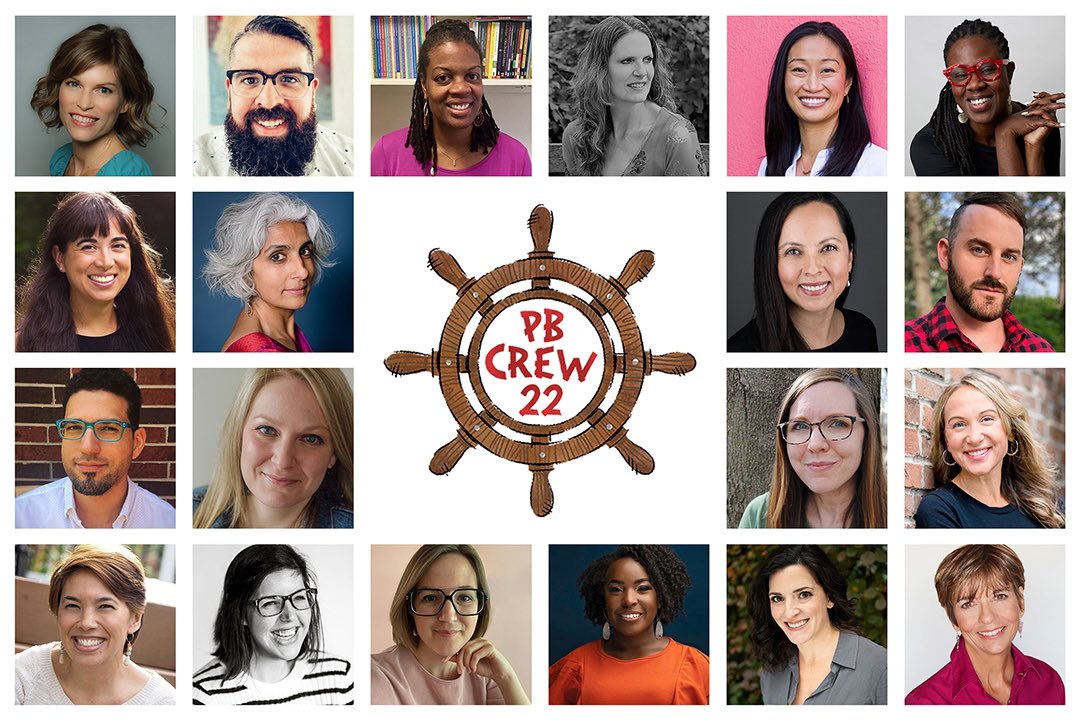
As a proud member of PB Crew 22 (shout out to all my crew-mates!) I have just enough experience to answer some of your burning questions.


WHAT A PROMO GROUP IS (AND IS NOT).

Sadly, a promo group is not a collection of top notch publicists summoned by your publisher to tirelessly promote your new book. No, in actuality most publishers would like you to pull quite a bit of weight in advancing your work. (You thought you were done selling it when you queried your agent, didn't you?) A promo group is a collection of debut authors and illustrators, usually all releasing traditionally published books in the same year. They are self organized, often 15-20 members large, and they work cooperatively to promote each other's books. Promo groups have a social media presence and some even have websites.

DO I NEED ONE?

Let's first look at what a promo group might accomplish. PB Crew 22 came up with a pretty expansive task list before I even joined them, which included a short introductory video, regular promotional posts on Twitter and Instagram, Pinterest boards for each book, reviews on Goodreads and Amazon, panel presentation opportunities, blog interviews, and book giveaways. (Phew!)

Clearly, a promo group can go a long way in helping you get your debut out in the world. I would say that a quarter of the Twitter followers I currently have are thanks to the countless tweets and retweets of my crew-mates. Our group had the opportunity to collectively create a post for Tara Lazar's Storystorm on how our books were born. I also have significantly more reviews for my 2022 releases than I would have without them.

I'm not the only one that feels this way. Crew member Laura Lavoie, author of Vampire Vacation said, "I think the reviews are the biggest way this group has helped me. I don't think I'd have nearly as many reviews if we weren't all doing them together for each of our books, and definitely not pre-release. That, and it's nice to have a built-in group to help boost each others' posts in a reciprocal way." Valerie Bolling, author of Together We Ride told me, "what I really like about our group is reading everyone's books that are all so good and knowing that members will read my 2022 books and post reviews and request them at their local libraries. I've appreciated the graphics that some members have created, amplifying my books on social media. It's also been good to present on panels with members from this group."

Beyond that, many promo group members feel they've gained a supportive network that goes beyond promotion. Lisa Tolin, author of How to be a Rock Star shared, "It's also been wonderful to learn from people who have been through this before. They've helped us understand things like how to approach bookstores or libraries. And within our group we have former teachers and booksellers, plus authors who have put together panels and teacher guides. That perspective has been so helpful to those of us who are new!"
My crew is more than an all-star team, it's become a network for support and advice.

So you definitely need a promo group, right?! Not necessarily. Being part of a promo group means you're not just promoting your own work, but the work of up to 20 other children's book creators as well. (In my case, 21 others!) And that can be, well... a lot of work! Ask yourself if you have the time and energy to write and post 20 reviews to multiple outlets, if you're willing to do frequent retweets for your group members, and if organizing panels and guest blog entries sounds like fun. If the answer is no, a promo group is probably not right for you. Keep in mind as well, that all this time spent on promotion can sometimes take away from time spent on your next project.

HOW DO I JOIN OR START A PROMO GROUP?

PB Crew 22 started when Cynthia Harmony, author of Mi Ciudad Sings reached out to Laurie Lavoie and asked if she was interested in starting a promotion group. They then reached out to Lisa Tolin and the three kept an eye on Twitter and Publisher's Weekly for picture book authors, illustrators, and author/illustrators with 2022 releases from Big 5 publishers. Through emails and DMs, the group slowly grew until it became its current size. I was lucky enough to meet Cynthia through an email thread for SCBWI EI Coordinators and she invited me to be the 22nd and final member of the crew.

They quickly established social media accounts for the group, but decided against a website and commissioned member Blythe Russo, author and illustrator of Sloth Sleeps Over to create the adorable banner below, among other graphics. Through email communication and group discussion over Zoom, PB Crew 22 created the initial task list mentioned above.

Our group logo, created by Blythe Russo

A promo group is just one tool in an author's publicity tool belt, but it can be a hefty one. If you are interested in starting a promo group of your own, start by following some of the ones mentioned above and note the types of content they produce and engagement they create. Then start asking around. Your local SCBWI chapter, Publisher's Weekly announcements, and social media are great places to find other debut authors and illustrators that may be interested in helping you get your work into the hands of readers... assuming you're willing to help them too.


Ellie Peterson is an author and illustrator of many picture books including HOW TO HUG A PUFFERFISH and SCHOOL IS WHEREVER I AM. Find out more about Ellie and her work at elliepetersonart.com


Monday, December 27, 2021

New Year Resolutions: Cal Newport Urges a Thoughtful Approach to Social Media So We Can Do Our Creative "Deep Work"

Cover of "Deep Work" by Cal Newport

Cal Newport's "Deep Work: Rules for Focused Success in a Distracted World" includes a section about figuring out if your time spent on social media makes sense for the larger picture of what you're hoping to accomplish. 

And one example Cal gives is for a writer (after citing a number of really successful authors who aren't on social media at all.) Here's part of the math Cal lays out for a "less famous" writer:

"Imagine that our hypothetical author diligently sends ten individualized tweets a day, five days a week—each of which connects one-on-one with a new potential reader. Now imagine that 50 percent of the people contacted in this manner become loyal fans who will definitely buy the author's next book. Over the two-year period it might take to write this book, this yields two thousand sales—a modest boost at best in a marketplace where bestseller status requires two or three times more sales per week. The question once again is not whether Twitter offers some benefits, but instead whether it offers enough benefits to offset its drag on your time and attention (two resources that are especially valuable to a writer.)"
—Cal Newport, from page 197-198 of Deep Work

As we look ahead to a new year of creative work, it's well worth doing this math for each of us - with everything we spend our time doing.

My thanks to Lori Snyder for the book recommendation.

Illustrate, Translate, and Write On,
Lee

Thursday, December 16, 2021

Social Media Followings Don't Necessarily Translate To Book Sales

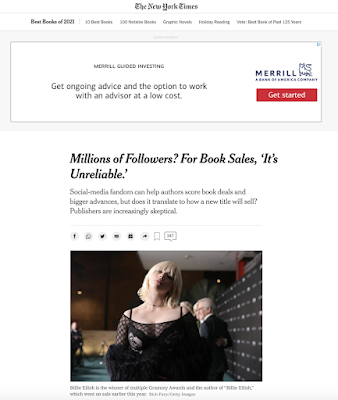
Elizabeth A. Harris wrote this really interesting article in the New York TimesMillions of Followers? For Book Sales, ‘It’s Unreliable.’

Screen shot of the New York Times article, featuring a photo of Billie Eilish


In it, Elizabeth explores both how publishers have been basing their publishing bets more and more on social media followings, and yet the evidence of book sales isn't aligning in the way those publishers expected.

The article opens with:

A book by Billie Eilish seemed like a great bet. One of the most famous pop stars in the world, Ms. Eilish has 97 million followers on Instagram and another 6 million on Twitter. If just a fraction of them bought her book, it would be a hit.

But her self-titled book has sold about 64,000 hardcover copies since it came out in May, according to NPD BookScan, which tracks most printed books sold in the United States — not necessarily a disappointing number, unless Ms. Eilish got a big advance. Which, of course, she did. The book cost her publisher well over $1 million.

The full piece is well-worth reading, and it's a reminder for all of us that racking up social media followers isn't necessarily going to lead to racking up the book sales.

Illustrate, Translate, and Write On,
Lee

Tuesday, November 9, 2021

Looking to Figure Out Your Approach to TikTok? BookBub Curated a list of 21 Authors On TikTok To Check Out


Shailee Shah starts out the article, 21 Authors on TikTok to Follow for Book Promo Ideas (&LOLs), with noting that 

“The BookTok hashtag currently stands at 12.2 billion views, with videos featuring books old and new.”

Music and text, vlog style, stitching reactions to other TikToks... there's lots to explore! And with the exception of the one movie star example, these strategies are all pretty much accessible to all of us creating content for tweens and teens.

Check out the full piece at BookBub Partners here.

Illustrate, Translate, and Write On,
Lee

Thursday, October 14, 2021

Leila Hirschfeld over at BookBub rounds up "15 Ways Authors Support Each Other on Social Media"


“Inspired by how authors have stepped up to build community and spotlight their fellow writers work," Leila Hirschfeld put together this BookBub Partners post, 15 Ways Authors Support Each Other on Social Media. It has lots of examples and ideas, including:

#1 Host book clubs featuring other authors’ titles

#7 Signal boost debut authors and encourage others to do the same

and

#10 Run giveaways of fellow authors’ books

How many are you currently doing? See any new ones to add to what you already do to support your fellow kid lit creators?

Read the full piece here.

Illustrate, Translate, and Write On,
Lee

Tuesday, July 20, 2021

Looking for Inspiration for Instagram? BookBub Spotlights 9 YA Authors "Running Fantastic Book Promotions on Instagram"


As part of Shailee Shah's curated list of "25 Authors Running Fantastic Book Promotions on Instagram," there are spotlights on Elise Bryant, who offers "a behind-the-scenes look at her author life"; Tahereh Mafi who "shares blurb[s] and excerpts from her upcoming releases amidst stunning lifestyle posts"; Kalynn Bayron, who "gives her followers sneak peeks into the publishing process of her books"; and Ransom Riggs, who "regularly shares posts and old photographs surrounding the lore of his series" and uses Instagram Live events; and more...

Check out the full roundup here, and be inspired with what you can do!

Illustrate, Translate, and Write On,
Lee

Thursday, April 1, 2021

The Power of #BookTok

As reported last week in Shelf Awareness, #BookTok Videos 'Starting to Influence Publishers and Bestseller Lists'

Noting that TikTok "is not an obvious destination for book buzz," the New York Times reported that "videos made mostly by women in their teens and 20s have come to dominate a growing niche under the hashtag #BookTok, where users recommend books, record time lapses of themselves reading, or sob openly into the camera after an emotionally crushing ending."

one example from the article:

Miriam Parker, a v-p and associate publisher at Ecco, said the company saw a sales spike for The Song of Achilles on August 9 last year, but couldn't figure out why. Ecco eventually traced it to a TikTok video called "books that will make you sob," published on August 8 by @moongirlreads. The video has now been viewed nearly six million times.

Have you checked out #BookTok?

Illustrate, Translate, and Write On,
Lee

Tuesday, March 2, 2021

Kacen Callender Talks Social Media Expectations... And How It Unfairly Makes Authors Feel Responsible for How Well (or Not Well) Their Book Sells

This recent post by National Book Award Winner (for King and the Dragonflies) Kacen Callender, WIP: Social Media Expectations is important reading.


Just recently at #NY21SCBWI the evaluation of an author's social media presence as a marker of a submission's potential -- something considered in the acquisitions process -- reinforced this industry advice: that we, as creators, have to be on social media, have to drive interest in our titles, for them to succeed.

Kacen describes that pressure in this way:

There’s an unspoken (and sometimes spoken) suggestion from publishing companies and professionals that, if the book doesn’t do as well as the author might’ve hoped, then it’s actually the author’s fault. They should have found a “street” team ("fans" paid to hype the book up online in a way that seems organic and natural), created their own pre-order campaigns (paying for swag, artists to draw their characters, etc.), pitched themselves to different media outlets, learned Photoshop to create graphics, paid someone to create a book trailer, hyped themselves up in a constant competition for attention online… the list goes on and on.

Kacen calls this out as gaslighting:

The gaslighting is this: the publishing companies and industry professionals know that the authors don’t actually control how well their book is going to do. They put that responsibility on the authors, when the responsibility is really meant to be on the publishing companies. That’s why we go with traditional publishing, isn’t it? That’s why so many of us don’t self-publish. We don’t have the necessary marketing skills. (I certainly don’t, anyway.) The marketing/publicity is ultimately publishing’s responsibility. The publishing companies have their budgets, and they spend those limited budgets on the books they expect will earn back a specific amount of money. Authors really don’t need to do anything to find that financial success. Case study A: Suzanne Collins. Where? Nowhere, that’s where. She doesn't do any publicity or marketing, from what I can see. Yet the Hunger Games series is—well, you already know. Clearly there isn’t actually a correlation between authors needing to do marketing and publicity and a book’s financial success.

There's so much more in the piece, and I encourage you to read it. And then, consider your relationship to the social media you do, and how much pressure you're putting on yourself to sell books via your engagement on social media. The math of social media effort to book sales, as Kacen points out, doesn't really move the needle.

I'll note that much of this centers on book sales, which is just one marker of a book's success. Connecting with an individual reader, making them see their own life, and maybe others, in a new way, is a huge part of why many of us create works for kids and teens. And maybe sharing that passion for crafting stories that help kids and teens find themselves and their place in the world is something that social media can help with. Maybe it's not all or nothing.

Everyone will find their own balance with creation and promotion -- and it's worth considering the pressure we put on ourselves and how much leverage our efforts may really have in each realm. Including our presence with and activity on social media.

Applause to Kacen for the courage to stand up and share their take on social media expectations.

What do you think? Share here in comments.

Illustrate, Translate, and Write On,
Lee


Tuesday, September 22, 2020

24 Content Ideas for Authors to Use on Social Media Gathered By Bookbub


In this BookBub Partners post, How Successful Authors Use Social Media: 24 Content Ideas, Leila Hirschfeld pulls together two dozen ideas that are working well for other authors.

Take a look through and see if there's an idea or two you haven't tried that resonates.

Unexpected and interesting ones that popped for me included: 

#4. Show props from a scene in a book, 

like in this example by Cheryl Bradshaw


and 

#15. Create little games for fans,

like in this example by Sylvia Day


The full piece is well-worth checking out.

Illustrate and Write On, Lee

Thursday, July 16, 2020

BookBub Curates "35 Authors Using Pinterest for Book Marketing & Inspiration"

Diana Urban has done another roundup of how authors are using social media - this time, how 35 Authors use Pinterest, with lots of YA authors included. Some standouts:

Dhonielle Clayton shares inspiration for the hairstyles of her characters in The Belles

Sarah J. Maas mixes inspiration and fan art on the boards for her books.

Marissa Meyer pins links to blog posts she's written as a guest at different outlets, making this board a media page.

Tomi Adeyemi has boards with writing prompts and advice

The inspiring roundup is well-worth checking out.

Are you on Pinterest? Feel free to leave a comment with how you use Pinterest and include a link!

Illustrate and Write On,
Lee