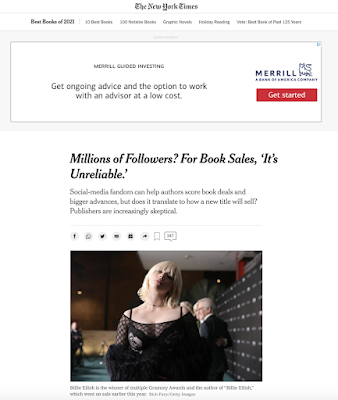
This recent post by National Book Award Winner (for King and the Dragonflies) Kacen Callender, WIP: Social Media Expectations is important reading.
Just recently at #NY21SCBWI the evaluation of an author's social media presence as a marker of a submission's potential -- something considered in the acquisitions process -- reinforced this industry advice: that we, as creators, have to be on social media, have to drive interest in our titles, for them to succeed.
Kacen describes that pressure in this way:
There’s an unspoken (and sometimes spoken) suggestion from publishing companies and professionals that, if the book doesn’t do as well as the author might’ve hoped, then it’s actually the author’s fault. They should have found a “street” team ("fans" paid to hype the book up online in a way that seems organic and natural), created their own pre-order campaigns (paying for swag, artists to draw their characters, etc.), pitched themselves to different media outlets, learned Photoshop to create graphics, paid someone to create a book trailer, hyped themselves up in a constant competition for attention online… the list goes on and on.
Kacen calls this out as gaslighting:
The gaslighting is this: the publishing companies and industry professionals know that the authors don’t actually control how well their book is going to do. They put that responsibility on the authors, when the responsibility is really meant to be on the publishing companies. That’s why we go with traditional publishing, isn’t it? That’s why so many of us don’t self-publish. We don’t have the necessary marketing skills. (I certainly don’t, anyway.) The marketing/publicity is ultimately publishing’s responsibility. The publishing companies have their budgets, and they spend those limited budgets on the books they expect will earn back a specific amount of money. Authors really don’t need to do anything to find that financial success. Case study A: Suzanne Collins. Where? Nowhere, that’s where. She doesn't do any publicity or marketing, from what I can see. Yet the Hunger Games series is—well, you already know. Clearly there isn’t actually a correlation between authors needing to do marketing and publicity and a book’s financial success.
There's so much more in the piece, and I encourage you to read it. And then, consider your relationship to the social media you do, and how much pressure you're putting on yourself to sell books via your engagement on social media. The math of social media effort to book sales, as Kacen points out, doesn't really move the needle.
I'll note that much of this centers on book sales, which is just one marker of a book's success. Connecting with an individual reader, making them see their own life, and maybe others, in a new way, is a huge part of why many of us create works for kids and teens. And maybe sharing that passion for crafting stories that help kids and teens find themselves and their place in the world is something that social media can help with. Maybe it's not all or nothing.
Everyone will find their own balance with creation and promotion -- and it's worth considering the pressure we put on ourselves and how much leverage our efforts may really have in each realm. Including our presence with and activity on social media.
Applause to Kacen for the courage to stand up and share their take on social media expectations.
What do you think? Share here in comments.
Illustrate, Translate, and Write On,
Lee