🌈 Happy Pride! Charlotte Sullivan Wild here, and I’m thrilled to share this interview with picture book author Joëlle Retener. They are about to receive a Stonewall Honor for their picture book Marley's Pride (illus. by DeAnn Wiley) at the American Library Association conference next week.
💜 Last year, one of my happiest surprises was when Joëlle asked to trade work, and we became fast friends. We connected through the Facebook group Disabled Kidlit Writers, hosted by Lillie Owens Lainoff (another star!). In addition to both being LGBTQ+ picture book authors, we have the same chronic illness. ME/CFS blocks a body’s ability to produce energy correctly or recover from exertion (physical, mental, emotional, and sensory). Finding a creative friend who doesn’t mind recording video messages while lying in a dark room is a gift! Now, I'd like to share the gift of Joëlle's interview!
📚 → Learn more about Joëlle’s recent and upcoming books.
✏️ My comments are bolded. Joëlle’s are in regular text. This interview has been edited for length and clarity. Let’s get started!
STONEWALL HONOR

Joëlle, CONGRATS on your ALA Stonewall Honor for Marley’s Pride! This is a beautiful story of how a queer Black grandparent supports their queer grandchild, by helping them navigate Pride with sensory sensitivities. The heart of this book is that Pride is about welcoming and supporting everyone.
What was it like to get “the call” about the Stonewall Honor and to have your work honored?
I was in complete disbelief. I broke down in tears and screeches of excitement! It was such an honor to be recognized. You and I have talked about this before, Charlotte… [historically], queer literature that’s recognized tends to be whitewashed and focused on the experiences of white gay men. The fact that my book that centers the journey of two trans-nonbinary Black individuals was recognized is a testament to the evolution of queer children’s literature. This win sends a message to people who share those intersecting identities that you’re seen and we value you. Your voices and your stories are worthy of being shared, are worthy of being uplifted. It was a powerful experience to know that something that I created is providing representation for my community in a way that has not been done, or at least not consistently.
It gives me hope that stories like mine, that children like me, that families like mine, can see themselves represented in books. Not only books about trans and nonbinary lives, but books that go beyond the normal tropes of coming out, [that] are centered in queer joy, and rooted in community, I think that’s a really big deal. Especially at a time when there is so much struggle within our community. To be reminded that the radical joy that comes with living authentically and being in community with others lives on is a gift. For my book to be shared broadly as a symbol of all that our community is, is humbling. I’m very grateful and hopeful that it will uplift folks who need the daily reminder that we are not alone. Joy is inherently part of our human experience no matter how we identify.
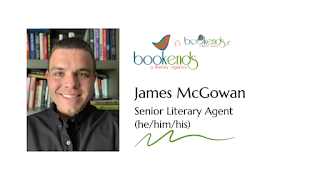
Both of us have had the hard experience of leaving our first agents. It sounds like you have landed in the right place with James McGowan at Bookends Literary Agency! (For those querying agents, James is focused on building his adult list right now.) What is that relationship like? I know that on my recent search I needed to figure out my own priorities…
I’m so grateful to be working with him! I feel like I have this superstar in my corner! James is really responsive. He has a great eye for how to strengthen my manuscripts in order to make them sellable. He is patient with all of my many, many questions. He is kind and funny and so snarky, and that’s what I love most about him! I can bring my full authentic self to the table when I’m working with him. While I recognize, yes, it’s a professional relationship, I can let my very short hair down when I’m with James. I feel so comfortable.
Most importantly, I genuinely believe that James loves my manuscripts. As someone who has historically been insecure about their writing, having an agent like James by my side has helped me to really fully perceive my work for what it is. It’s been such a magical experience. I couldn’t imagine working with anybody else.
The search for the right agent can be so tricky. It’s encouraging to know that this is possible with time and patience!

I was in complete disbelief. I broke down in tears and screeches of excitement! It was such an honor to be recognized. You and I have talked about this before, Charlotte… [historically], queer literature that’s recognized tends to be whitewashed and focused on the experiences of white gay men. The fact that my book that centers the journey of two trans-nonbinary Black individuals was recognized is a testament to the evolution of queer children’s literature. This win sends a message to people who share those intersecting identities that you’re seen and we value you. Your voices and your stories are worthy of being shared, are worthy of being uplifted. It was a powerful experience to know that something that I created is providing representation for my community in a way that has not been done, or at least not consistently.
It gives me hope that stories like mine, that children like me, that families like mine, can see themselves represented in books. Not only books about trans and nonbinary lives, but books that go beyond the normal tropes of coming out, [that] are centered in queer joy, and rooted in community, I think that’s a really big deal. Especially at a time when there is so much struggle within our community. To be reminded that the radical joy that comes with living authentically and being in community with others lives on is a gift. For my book to be shared broadly as a symbol of all that our community is, is humbling. I’m very grateful and hopeful that it will uplift folks who need the daily reminder that we are not alone. Joy is inherently part of our human experience no matter how we identify.
AGENTS!

Both of us have had the hard experience of leaving our first agents. It sounds like you have landed in the right place with James McGowan at Bookends Literary Agency! (For those querying agents, James is focused on building his adult list right now.) What is that relationship like? I know that on my recent search I needed to figure out my own priorities…
I’m so grateful to be working with him! I feel like I have this superstar in my corner! James is really responsive. He has a great eye for how to strengthen my manuscripts in order to make them sellable. He is patient with all of my many, many questions. He is kind and funny and so snarky, and that’s what I love most about him! I can bring my full authentic self to the table when I’m working with him. While I recognize, yes, it’s a professional relationship, I can let my very short hair down when I’m with James. I feel so comfortable.
Most importantly, I genuinely believe that James loves my manuscripts. As someone who has historically been insecure about their writing, having an agent like James by my side has helped me to really fully perceive my work for what it is. It’s been such a magical experience. I couldn’t imagine working with anybody else.
The search for the right agent can be so tricky. It’s encouraging to know that this is possible with time and patience!
WRITING WHILE DISABLED

The new logo for the Disabled Kidlit Writers group on Facebook, where Joëlle and I met.
How does disability influence the way you write and what you write?
I have a dynamic chronic illness [meaning, the severity fluctuates], so I live my life in seasons, from flare to flare. As a result, my writing is also seasonal. [Flares] impact me both physically and mentally since my disability affects my cognitive function. The typical advice is to write, write, write, as much as you can! You must be a prolific writer! The reality is that I can’t be. I can only write based on how my chronic illness is behaving.
I relate! When I became ill, the focus shifted from “how much” I work to “how to” work around physical and cognitive limits. Whether one is disabled or caregiving or working long hours, working harder isn’t always an option.
Often times, I’m not writing, but I’m reading, listening to audio books, which are incredible when you don’t have the physical capacity to read. During these periods of “dormancy” I focus on documenting the ideas that bubble up. My creativity is usually dying to come through and this is an easy way to feed it even if I’m not able to fully create stories in those moments. (Yes!)
My disability has also allowed me to explore different ways to write. When sitting up is difficult, I’ll write from [bed]. (Ditto!) Sometimes, physical typing or looking at my computer screen isn’t accessible to me. I use talk-to-text apps instead and leave myself voice memos to think through ideas or concepts. I save them like sticky [notes] to circle back when I have the space to do so.
Does disability affect what you write?
My disability has made me even more determined and passionate about writing inclusive stories. It’s so important for children, but also [for] the parents who are reading, to see themselves in books. I want to remind readers that they belong. Black people belong. Black trans - Black Queer people belong, and disabled people belong, especially in spaces that have been historically inaccessible to those communities, such as nature/the outdoors. We exist in this world, right? To assume that disabled people aren’t all around us is just unrealistic. Which is why I make a concerted effort to work with my editors and illustrators to have disabled people represented. [I try] to ensure that that representation is present in whatever I touch.

How is creative community different when you live with disabilities? What do you wish people knew?
Thank you for this question! I don’t often get opportunities to talk about my disability and how it impacts me as a creative. Shedding a light on it could help other spoonie creatives like me to feel a little bit less alone.
How does disability influence the way you write and what you write?
I have a dynamic chronic illness [meaning, the severity fluctuates], so I live my life in seasons, from flare to flare. As a result, my writing is also seasonal. [Flares] impact me both physically and mentally since my disability affects my cognitive function. The typical advice is to write, write, write, as much as you can! You must be a prolific writer! The reality is that I can’t be. I can only write based on how my chronic illness is behaving.
I relate! When I became ill, the focus shifted from “how much” I work to “how to” work around physical and cognitive limits. Whether one is disabled or caregiving or working long hours, working harder isn’t always an option.
Often times, I’m not writing, but I’m reading, listening to audio books, which are incredible when you don’t have the physical capacity to read. During these periods of “dormancy” I focus on documenting the ideas that bubble up. My creativity is usually dying to come through and this is an easy way to feed it even if I’m not able to fully create stories in those moments. (Yes!)
My disability has also allowed me to explore different ways to write. When sitting up is difficult, I’ll write from [bed]. (Ditto!) Sometimes, physical typing or looking at my computer screen isn’t accessible to me. I use talk-to-text apps instead and leave myself voice memos to think through ideas or concepts. I save them like sticky [notes] to circle back when I have the space to do so.
Does disability affect what you write?
My disability has made me even more determined and passionate about writing inclusive stories. It’s so important for children, but also [for] the parents who are reading, to see themselves in books. I want to remind readers that they belong. Black people belong. Black trans - Black Queer people belong, and disabled people belong, especially in spaces that have been historically inaccessible to those communities, such as nature/the outdoors. We exist in this world, right? To assume that disabled people aren’t all around us is just unrealistic. Which is why I make a concerted effort to work with my editors and illustrators to have disabled people represented. [I try] to ensure that that representation is present in whatever I touch.
FINDING CREATIVE COMMUNITY WHILE DISABLED
For me, isolation has been the hardest part of becoming chronically ill – worse than the illness itself, which is why your friendship has been such a joy, Joëlle! (I wrote about this for SCBWI in 2023: “Cures for Loneliness: Writing and Illustrating Disability.”)How is creative community different when you live with disabilities? What do you wish people knew?
Thank you for this question! I don’t often get opportunities to talk about my disability and how it impacts me as a creative. Shedding a light on it could help other spoonie creatives like me to feel a little bit less alone.
(SIDEBAR: Christine Miserandino coined spoon theory as a way to measure energy with metaphorical “spoons.” People with disabilities may have significantly fewer or a fluctuating number of daily “spoons” compared to non-disabled people. “Spoonies” are people who have to pace their energy very differently than non-disabled people. Now, back to Joëlle!)

I really struggle with connecting with the kidlit community. There are so many platforms where we can engage. While I’m really grateful for those digital spaces, keeping up feels impossible. Being on apps like Bluesky and Discord feels like stepping into a really loud room and you have a sensory sensitivity. Like, there’s constant noise coming at [me], and I am incapable of sift[ing] through it.
Sometimes, when I’m having good body days and my mind isn’t as foggy, I try to jump on. I want to be around my people. I want to share the ups and downs that are part and parcel of the publishing business. But it’s difficult. And my enthusiasm doesn’t last long. It can be really isolating not to be able to connect with other creatives in those spaces. It’s often a choice between [that] and showing up in the real world for myself or my family. That means I don’t get [many] opportunities to connect with other creatives.
That’s so hard.
One of the few gifts of the pandemic was that more events are now online, which means that homebound or disabled people can at least watch events when in-person or live attendance is impossible. This also reduces travel costs, another barrier. I appreciate when webinars are archived for a month, so I can watch them in parts if I can’t concentrate for 1-2 hours or if it’s a bad health season. But for those able to attend some events, there are still barriers, right?
In person get-togethers are so difficult. They usually require travel, which looks like me schlepping my entire family to these events. Then there’s naturally lots and lots of socializing which takes weeks for me to recover from on the back end. I don’t think most people understand how taxing it can be for people [with] chronic condition[s] to simply leave their homes let alone all the planning and prepping that comes with attending larger social gatherings. It is a struggle and it can be very lonely.

I’m really grateful for the writing friends who I connect with one-on-one, via Marco Polo (a free video messaging app) or voice memos on texts.
Ultimately, it is very much about trying to find accommodations and exploring different avenues for connection.
It’s my hope that this blog post will help able kidlit creatives to better understand the spoonie struggle. Then perhaps we could find ways to reduce the emotional and mental labor that’s typically shouldered by their chronically ill counterparts when seeking out community.
Thank you for sharing your experiences, friend.
WHAT ARE YOU READING?
Last, what is something you’ve read that is lighting you up?
Micro Activism: How You Can Make a Difference in the World (Without a Bullhorn)
Small Actions = Big Results
By Omkari L. Williams
Forward by Layla F. Saad
Gosh, this book really stuck with me! It's about how to make activism accessible to everyone. Williams talks about the perception [of] activist[s] and what [they] look like. More often than not, activism is perceived as being at the front lines with a bullhorn, on stage. The reality is that activism is more all-encompassing, and [we] need to see it from a holistic perspective. Activism is accessible to everyone, which to me is an incredible realization given my health issues.
Yes! Recently, a disabled author friend was processing with me how much she wanted to march at protests, but she is unable to do so physically. She did feel proud that her son marched. Raising him is part of her radical work. So are her stories and donations. We can show up in our own ways.
[In] the forward, Saad [says] that for the longest time, she did not consider herself an activist because she did not fit the quintessential image of an activist. But as Williams notes, activism is a verb. It’s a verb that describes actions that you take in order to move forward the greater good of humanity.
I’ve had to really rethink how I show up in this world, specifically [with] my social justice work. This book has allowed me to own it, and to embrace it. It has allowed me to recognize how my storytelling is one hundred percent activism! Yes, I have said it! I’ve said it!
I agree!
My disability has forced me to let go of a lot of things. [But this] book allowed me to see that maybe it’s not a releasing of the social justice part of my life, [which] is so fundamental to who I am. Perhaps it’s a reframing of how I approach my activism, and an opportunity to find new ways to lean into it.
I love that! Thank you for sharing your heart and experiences, Joëlle!
If you’re headed to ALA, look for Joëlle and their beautiful book Marley’s Pride! Check out what's next from Joëlle!

Wishing you all joy and community for your journey!
💜
In case you missed them, here are my previous posts for June:
“Pointless Joy! Returning to the Heart in our Art”
“My Process, My Nightmare!”
💜
Joëlle Retener is the author of Marley’s Pride a Stonewall Honor book, which received starred reviews from Kirkus, Publisher’s Weekly, and Booklist, and OUR WORLD: USA. Their forthcoming books include MADINA’S BIG, FABULOUS, WIN and its sequel (Disney Hyperion ’26), and BELLY GROWLS (Henry Holt 27′). As a Black Kreyol, disabled, nonbinary creative, Joëlle believes that art is a vehicle to rewrite and reimagine outdated narratives about historically marginalized communities. Joëlle is a proud graduate of Spelman College and American University. They are represented by James McGowan at Bookends Literary Agency. Learn more: www.joelleretener.com
Charlotte Sullivan Wild is the author of several picture books. Love, Violet (illus. Charlene Chua) is a Stonewall Book Award winner, Charlotte Huck Honor Book, and Lambda Literary Award Finalist. The Amazing Idea of You (illus. Mary Lundquist) is a lyrical celebration of the potential in living things, especially in every child. She has taught language arts, literature and writing, worked as a bookseller, and volunteered as the SCBWI RA for Southwest Texas. She is represented by Analía Cabello at Andrea Brown Literary Agency. Learn more: www.CharlotteSWild.com
💜
In case you missed them, here are my previous posts for June:
“Pointless Joy! Returning to the Heart in our Art”
“My Process, My Nightmare!”
💜
Joëlle Retener is the author of Marley’s Pride a Stonewall Honor book, which received starred reviews from Kirkus, Publisher’s Weekly, and Booklist, and OUR WORLD: USA. Their forthcoming books include MADINA’S BIG, FABULOUS, WIN and its sequel (Disney Hyperion ’26), and BELLY GROWLS (Henry Holt 27′). As a Black Kreyol, disabled, nonbinary creative, Joëlle believes that art is a vehicle to rewrite and reimagine outdated narratives about historically marginalized communities. Joëlle is a proud graduate of Spelman College and American University. They are represented by James McGowan at Bookends Literary Agency. Learn more: www.joelleretener.com
Charlotte Sullivan Wild is the author of several picture books. Love, Violet (illus. Charlene Chua) is a Stonewall Book Award winner, Charlotte Huck Honor Book, and Lambda Literary Award Finalist. The Amazing Idea of You (illus. Mary Lundquist) is a lyrical celebration of the potential in living things, especially in every child. She has taught language arts, literature and writing, worked as a bookseller, and volunteered as the SCBWI RA for Southwest Texas. She is represented by Analía Cabello at Andrea Brown Literary Agency. Learn more: www.CharlotteSWild.com