Showing posts with label author/illustrator. Show all posts

Thursday, May 28, 2026

Deep Dives with Merfolx: A Sparkling Interview with Jessica Love

Happy Thursday! We are back with the final installment of our MerMay entries, and I am over the coral moon about this one— an interview with the one and only, Jessica Love! The author and illustrator of one of my favorite books of all time, I feel so privileged and honored to have her on the Official SCWBI Blog. SO without further ado, let's get started!

 Hi Jessica, I am so beyond excited for you to join us on the Official SCBWI Blog. The wonderful author/illustrator of Julián is a Mermaid, and Julián at the Wedding, please tell us a little about yourself, in your own words.

Thank you so much for having me, Justin. When I was about nine years old my answer to the question "what do you want to do when you grow up?" was actor, artist, writer. Which is a pretentious answer for a nine year old but oh well, I suppose I was a little bit pretentious, but I guess I meant what I said because I've done all three of those things professionally as an adult. My parents are both artists--my mom is a weaver, my dad is a potter, and my extended family on both sides is made up of highly creative people. 

I grew up in Santa Barbara, California. I've always drawn and painted, and from as far back as I can remember I was making up stories and illustrating them. I was passionate about playing pretend, I was definitely one of those kids who would live inside a game for days at a time. Eventually I discovered theater, which felt like a bigger game of make believe, and I really fell in love with it. But I think both of my interests (visual art and theater) spring from an interest in make-believe.

 I see that you studied Drama at Juilliard and was a professional actor until you moved into publishing, very similarly to me being a dancer turned illustrator. How has your background in the theater world shaped your storytelling as an author/illustrator and how was that transition?

I didn't know you were a dancer! That makes me very happy. I am currently at work on the third Julián book in the series, and it is called, Julián is a Dancer. It's about that threshold moment when you enter a creative process with other people for the first time, and how intimidating it is at first but also how thrilling once the first step into the room has been taken. 

So yes, I was an actor in New York City for many years. I moved to New York after studying Visual Art and doing Shakespeare plays at UC Santa Cruz, to study Drama at Juilliard. After graduation I stayed in New York working as an actor in new plays and very old ones. I loved it. While I was doing that I had the idea for Julián is a Mermaid and started working on it whenever I had time. I developed it slowly over several years, the last draft I did before I started submitting it was completed backstage in my dressing room in a play called "The River". The actor (and brilliant writer as well, by the way) Mary Louise Parker helped me meet my wonderful agent, Meredith Kaffel-Simonoff, who immediately understood what I was trying to do with Julián and really guided me through the process of crafting a proposal and readying it for submission. 

So there were lots of practical ways my work as an actor informed my pivot to this new industry. But on a process level I think I am making use of much of the same vocabulary, and using similar principals as guidelines. In drama school one of the phrases you hear most often is "be specific" which is something I really try to do in my illustration. I like for every character to feel as embodied as possible, that's important to me. I think I also see the page as a kind of stage, in terms of the way I like to frame action. Another virtue of the theater I want to try to keep in mind more often is the possibility that is afforded by a really deep depth of field, it allows several different threads to be at play at once, and that's something I love in art, any kind of polyphony. I think I also tend to sort of act while I'm drawing, I'm making the faces, I'm trying out the movements in my own body. I also try to think of drafts of a book as rehearsal--a physical process you use to get the story in your body, so that when you do the final art I know what I'm doing so I can be loose.

When Julián is a Mermaid came out, everyone I know and who know the true me sent me the announcement. Not to exaggerate, but this is one of my favorite children's books ever. I've never felt more seen in a book. I, too, grew up in New York, had a secret love of mermaids, but unlike Julián, I didn't show my true love until I was older. 
I'd love to hear what inspired you to create the book and how did Julián come to you as he is? I mean, did you hear stories of me when I was eight years old?!

Wow, I love this question so much. It is incredibly, powerfully affirming to me to get to hear that from a reader, thank you so much. 

I had a very clear goal for myself, which was to make the Juliáns of the world feel seen, and even celebrated by that seeing. I was deeply inspired by the documentary Paris is Burning about the golden age of the ballroom scene in New York in the '80's, the first time I saw it I immediately watched it over from the beginning. Those ballroom artists had created something astonishing. I was also pained by how many of those kids--because they were so young!--had been forced out of their birth families due to their unwillingness to reign in their self-expression. And of course they created new families with long legacies in the establishment of the different houses and family structures in which this culture thrived. 

With this picture book I wanted to reach way back to the early childhood of kids like Julián, and give them a story in which they express something deep about themselves, and are seen for who they are, and celebrated. Just a story of pure love and recognition being exchanged between two generations. I wanted to bottle that feeling you get when one of your elders really sees you and loves what they see. I really didn't write the book with just kids in mind, I had hoped it would reach the grown mermaids too, so it makes me so happy to hear your saw yourself in it's pages.

As a New York, I've attended the Mermaid Parade for several years. It is sort of my Pride celebration. I've always loved the parade just from its sheer inclusiveness. Being a mermaids doesn't come with the expectations and standards of what it means to be "human." It is a celebration of all people, from all backgrounds, ages, body types, cultures, etc. What drives you as an artist to celebrate representation in your work and in the book space?

This is what I love about the Mermaid Parade too! Despite being a dress-up as a fantastical creature parade, it is its human-ness that is moving to me. I love that it's on a day when it's SO hot and it's in the direct sun so everybody is all sweaty, and kind of naked, and truly, truly the crowd is made up of a raucously heterogenous sample of New York Humans, I absolutely love it. 


I think showing the world we live in means showing a diverse world. And beyond being accurate, beyond being fair, it's interesting to move your point of view around, and to remember that really it is only ever just that, a point of view in an vast number of points, each as real as you.

I just saw the announcement that Julián is a Mermaid will be making its way to become an animated feature, led by the Academy Award nominated director Louise Bagnall with Cartoon Saloon. How did it feel to be approached about the adaption and what are your hopes for the feature?

I am so excited for this film to come out. Louise and an absolutely incredible team of animators from all over the world have been working so hard on this for years and years. The script is written by Juliany Taveras, who is also a playwright and the way they managed to expand a 30 word story into a feature length film while maintaining the original bones of the house is a pretty awesome feat of ekphrasis. It's beautifully done, Cartoon Saloon is one of the last studios actually drawing everything by hand, which is really meaningful to me. A human hand was important in this story.

Last question, which I know I've personally pondered for ages, but if you were to sprout a tail right this second, what would it look like?

I'm so glad you asked. This season my tail is going to be like a black plum with the occasional scale of nacreous pearl, but my fins will be tipped in vermillion.

Check out more about Jessica Love, HERE, and follow her on Instagram @jesslovedraws.

That's all, Merfolx! Thank you for joining me on this month long journey through the seas! As MerMay comes to an end, I hope you've celebrated your mermaid-ness but also, in doing so, as Jessica said, your humanness! And for those who are in the NYC area, the Mermaid Parade is June 20th! Hope to see you there! Ciao!

Thursday, March 23, 2023

Ten Random Thoughts From an Author/Illustrator


    As I was racking my brain for what to write for this post, I had two problems. I had no ideas, yet also too many ideas. Random phrases and miscellaneous publishing thoughts kept inserting themselves onto the page. However, as soon as I typed them out, my mind went blank.

    So instead of making a choice, I’ve decided to share them all with you. Here are my top ten random thoughts about writing, illustrating, and being a creative person, in no particular order. (Complete with random art!) 

1. Trust Your Reader

     When we are writing or illustrating, we should intentionally leave room for the reader or the viewer. Sometimes we get feedback asking us to explain things more thoroughly or assuming that our audience won’t pick up on the intended message of the book. When you get this type of feedback, consider: If I take this feedback will I be over-explaining? Is there, in fact, something missing that is making the message unclear? Or if I add more details, am I not trusting my reader?

2. Blank Pages Are The Worst

illustration of a child and a zebra sitting and painting pictures, making a mess. Text on image reads: be an artist, make a mess
Be An Artist - Illustration by Anne Appert
    Get something, ANYTHING on the page. You never know where it will take you. A chance phrase may just be the idea that carries your story or illustration across the finish line. When brainstorming this post, I wrote “light up sneakers” on the page because it popped into my head as I was pondering ideas, and didn’t want to be staring at a blank page anymore. This phrase helped me arrive at the idea to share my ten random thoughts. You never know where seemingly unrelated ideas will lead you!

3. Everything Takes Time. And Always More Than You Think It Should

    The amount of time you think something should take? Double it. Triple it. It is incredibly satisfying to reach your audience with your book(s), but publishing is a slow industry. One of my favorite pieces of advice that I have ever received was from one of my college professors: If you don’t give up, you will succeed. In publishing, just know this could take two or five or ten or twenty (or more) years. However, if you are passionate about getting your stories into books for children to read, it will be worth it. 

4. Any Idea Can Be A Good One, With A Little Work

    Okay, I know people will disagree with me on this one. Hear me out. If you thought it was worth writing down, if it made you laugh or someone else laugh, if someone started building off your “silly” idea when they heard it, then maybe, just maybe, there is a seed of something there. Just like a random phrase can lead to a post worth sharing, a bad idea can lead to a good idea worth writing or drawing. You may just have to polish it a bit (ok a lot) before it shines.

Illustration of a child riding a zebra, both are wearing sunglasses and a party hat as a unicorn horn. Text on image reads Be your own unicorn
Be Your Own Unicorn - Illustration by Anne Appert 
5. Put Yourself On The Page

    My first post for this blog was about how BLOB helped me discover myself. You may think you don’t have anything new or unique to say, but your writing and art will surprise you. By being you, by allowing yourself to be vulnerable, by allowing yourself to be silly or frustrated, happy or sad, by letting yourself feel whatever thing you are feeling, you will connect with your audience.


6. It’s Always Okay To Buy Another Notebook Or Sketchbook

    Don’t even question it. Of course you need it. It may just be the thing that unlocks your next idea! You never know, and you wouldn’t want to risk anything by NOT buying the notebook/sketchbook. Right? 

7. Always Tell A Story

    As writing advice this may seem obvious; however, sometimes we get so caught up in adding elements such as alliteration, repetition, and lyrical language that the story gets lost. The story is what is important. Always. As for drawing advice, you can create a gorgeous painting, but if it doesn’t tell the viewer a story, you won’t be hired to create a book. Always think: what story am I trying to tell? What details can I add? How can I hint at the before and after? How can I get the reader or the viewer to ask, what happens next?

8. When In Doubt, Add Sparkles

    Those light up sneakers? Of course your character needs them! While we don’t want our story to get lost in too many unnecessary elements, a little extra bling in the form of outrageous outfits, creative color choices, or alliterative adjectives can bring your manuscript or illustration to the next level.

9. It’s Okay To Be Not Ok

Image of a child crying, sitting next to a zebra. text on image reads it's ok if some days your eyes shine more than they sparkle.
It's Ok to Be Sad - Illustration by Anne Appert
    Hey! We are still in a pandemic. Life is hard. Writing is hard. Illustrating is hard. Maybe you got a rejection from your dream agent. Maybe your advance was lower than you wanted. Maybe you didn't get the call to illustrate the book you really wanted to illustrate. Maybe you are burnt out and can’t think of a single idea for anything, not even a blog post. Sometimes we try to squash our feelings because we convince ourselves we should just be happy with how far we’ve come, that because we have had some success our feelings aren’t valid. Publishing can still be disappointing, and It’s ok to feel how you feel.


10. Celebrate Everything

    Sold a book? Celebrate! Signed with an agent? Celebrate! Finished your book dummy? Celebrate! Figured out that ending you could never get right? Celebrate! Finished a sketch that was keeping you up? Celebrate! Made it to your computer to write? Celebrate! Decided to take a self care day? Celebrate! Cleaned off your desk? Celebrate! Went on an artist date? You know what to do.

Bonus Thought! Ignore Everything I’ve Said

    Everyone's journey is different. Everyone has opinions about the right way to do things and the correct path to success. As with a critique of your work, perhaps some of this stuff feels superficial or unimportant to you. That’s ok! You find you and your own path. Then, celebrate that.

    Maybe add some sparkle too. Just for good measure.

    And of course, buy that notebook.


Photo of author with purple hair in yellow shirt. they are smiling in front of a green foliage background
Anne Appert (they/them ) is a nonbinary author/illustrator who spent their childhood with their nose stuck in a book, while their wild imagination transformed their New Jersey backyard into faraway places. Anne still enjoys spending time in their backyard dreaming, and now their imagination turns their dreams into words and pictures for children. Anne wrote and illustrated their debut book Blob, which was published by HarperCollins in Fall of 2021. Their second book What If You Wish? will publish with HarperCollins in 2024. They are a member of SCBWI, from which they received an honor in the 2021 Conference Portfolio Showcase. When not writing and illustrating, Anne enjoys teaching college students, dying their hair every color of the rainbow, and attempting to roller skate. You can see their work at anneappert.com.

Friday, March 17, 2023

When in Doubt: Change Locations!

Have you ever felt super stuck?

Like the jar of a lid that refuses to budge stuck?

Like you wore too many socks with your snow boots and now you can’t get them off stuck?

Like you typed some words and deleted them just to type the same words again stuck?

Like why am I even attempting this because it won’t be good stuck?

    Perhaps you get to the point where, out of desperation, you try something new. Recently, I impulsively booked a writing retreat. I thought I might try the “change your location” trick to get myself writing again. Amazingly, and perhaps unsurprisingly, it worked. In addition, by leaving my space and writing somewhere new, I also remembered the habits I used to have within my own studio space to create this same kind of experience at home: a desk for writing, a table for drawing, a couch for reading (Admittedly, most of my work gets done on the couch).  


sunset over a shed and a winter grassy area
A sunset at the Highlights Foundation
  I realize this is not new or original advice. I also realize that many of us can’t impulsively book writing retreats and run away from other obligations. However, as I was walking during a writing break while on retreat, I had a realization: this advice doesn’t just work to get your creative wheels turning again. It can also help get your story or art unstuck.

Is your story super stuck?

Like your character has run out of things to say stuck?

Like you need to get to a plot point but what you just wrote won’t get you there stuck?

    Try changing locations! If you are bored with your story or character, consider putting them in a new setting and see what happens. What do you discover about your character? Your story? Who do they meet? How do they change? What secrets does this uncover for them? For your story? Now, with the answers to those questions, infuse new life into your project.

    The same can go for portfolio development or when creating a book dummy.

Is your art super stuck?

Like you always draw the same characters and emotions stuck?

Like you have created all your stories in the same setting stuck?

    Try changing locations! If you are bored with your art, try putting your characters in new settings and see what happens. What would they do in that location? Who would they meet? How do they feel about it? What angle would add to the emotion of the scene? Can you create sequential images of the same character in different settings? Now, with the answers to those questions, start creating some new art.

    
Illustration of a child in a boat fighting off giant dragonflies with their oar
Take your characters on a journey. Illustration by Anne Appert 

    One thing to avoid when changing locations is relying to much on here-to-there scenes to hit your word count. In writing, consider what is most important in the journey to the changed location and cut everything else. Do we even need the in between scene? Can this just be a writing aid to get you to the next chapter? In art, the journey should still tell a story. Even when creating sequential art, consider what is most important to show to tell the entire story, and cut everything else. Do we need to see every action between each illustration? Or can these just be an illustration aid to get you to the next scene? The here-to-there may be useful for you as a creator, but remember to trust your readers or viewers to be able to fill in the gaps in order to create your strongest work.

    I wish I could book a trip every time I felt super stuck. However, I can change my characters’ locations in my stories or in my art when I am feeling creatively stumped. These could just be exercises that help me know my characters better, that give me new ideas for my stories, or that introduce me to a new illustration style I want to investigate further. Even if these journeys don’t end up in my stories or in my art, they were worth the time to get me from there to here.

From stuck to inspired.

It could even bring us from I don’t know why I do this stuck to I remembered what I love about the process inspired.

I hope it does!


Image of person with short purple hair in yellow shirt, smiling in front of a green backgroundAnne Appert (they/them ) is a nonbinary author/illustrator who spent their childhood with their nose stuck in a book, while their wild imagination transformed their New Jersey backyard into faraway places. Anne still enjoys spending time in their backyard dreaming, and now their imagination turns their dreams into words and pictures for children. Anne wrote and illustrated their debut book Blob, which was published by HarperCollins in Fall of 2021. Their second book What If You Wish? will publish with HarperCollins in 2024. They are a member of SCBWI, from which they received an honor in the 2021 Conference Portfolio Showcase. When not writing and illustrating, Anne enjoys teaching college students, dying their hair every color of the rainbow, and attempting to roller skate. You can see their work at anneappert.com.

Thursday, March 9, 2023

So You Want to be an Author/Illustrator


    Frustration is growing among querying picture book creators: currently many agents seem to only want author/illustrator submissions. As a writer-only creator or an illustrating-only creator you may be wondering if you need to be able to both write and illustrate to succeed in this industry. The short answer is no! Take a look at the picture books currently being published and you’ll see that many are still created by a separate author and illustrator. However, you may decide you want to learn to write or illustrate anyway. Do you know where to start? Learning a new aspect of picture book creation can be completely overwhelming, so let’s start with five things you can do.

5 Things To Do As A Writer Who Wants to Illustrate
  
cover of the book Picture This: How Pictures Work by Molly Bang. White cover with 4 black rectangles at varying places and one red triangle.
First, assess why you want to illustrate. Learning to illustrate simply in order to get an agent is not going to be a sustainable motivation. In addition, it is not a quick fix for your querying woes! A lot goes into creating an illustration and this takes time to learn. However, if you enjoy making art, it’s worth exploring illustrating.

    The second thing to do is draw every day for a year. You may have loved art in high school, and may even dabble in it now. Making art is fun! However, illustrating a picture book is a big time commitment, and you will quickly burn out if the process isn’t something you can stick with. Drawing every day for a year is a good way to determine if you actually enjoy the commitment of making art. It’s also a great way to improve your skills.

    Now that you know why you want to illustrate and you know you enjoy making art, the next step is to take art classes and learn the language of art. Just like writing has particular skills to make your work stronger such as sentence structure, word choice, repetition, and more, illustrating has particular skills you will need. These include composition, color choice, character design, and many other things. You do not need an art degree to be an illustrator, and there are many great online options for learning art.

    While taking art classes, start step four: study picture book illustrations. Take what you are learning about art and see how illustrators apply these concepts to picture books. In addition, study how illustrators build on the text, how they pace the images to aid the reading experience, and what choices they make with composition and color to create a visual arc throughout the book.

    Finally, make a lot of art. A LOT OF ART. The more art you create the more consistently you will make good art. Many people jump right into creating a picture book dummy when they move from writing to writing and illustrating. Before you do that, you will need a website of your 10-20 strongest images. When an agent or editor sees your dummy, they are going to want to visit your portfolio to see that you can create consistently strong art.

5 Things To Do As An Illustrator Who Wants to Write

  
cover of Writing Picture Books by Ann Whitford Paul showing a child riding an animal through a scene filled with trees.
    First, assess why you want to write. Writing is less time consuming than illustrating, but you still need to stand out with a unique voice in this competitive market. Usually author/illustrated books have more time between their publication dates, so if you are looking to create more books, this may not be the way to do it. However, if you have a story to tell, learning to write is worth exploring.

    Next, study picture book texts, particularly those written and illustrated by the same person. A common mistake illustrators learning to write make is describing exactly what they are illustrating with their text. Study how picture book art and text works together while not being the same.

    Then, take some writing classes or go to some writing workshops. While many of us know the basics of writing, you will want to learn how this applies specifically to picture books. Published authors have great insight into the particulars of picture book creation.

    While you are attending writing workshops, try creating some stories. Starting from scratch can be intimidating, so try taking one of the illustrations from your portfolio and creating a story for it. Before you know it, you will have a loose structure for a picture book.

    Finally, write a lot of drafts. A LOT OF DRAFTS. The more you write, the more you will figure out pacing, word choice, and how to compliment your art rather than repeat it. The more you practice, the stronger your storytelling voice will get.


3 Tips For Both Writers And Illustrators

    While you are learning how to write or illustrate, I recommend reading WRITING PICTURE BOOKS by Ann Whitford Paul and PICTURE THIS: HOW PICTURES WORK by Molly Bang. These books are both essential reading for picture book creators.

    In addition, get feedback on your work. This can be from a critique group or a paid critique from a professional. I recommend making connections with other writers and illustrators to form a critique group or critique swap before paying anyone for feedback.

    Finally, however long you think it’s going to take to learn to write or illustrate, double that. These are skills that take some time to master, particularly illustration. (If you don’t believe me, ask any published writer or illustrator how long it took them before they signed with an agent and then got published.) Publishing is a slow industry, and it’s worth taking your time to create work that will stand out in a competitive field.


    While I’ve given feedback to many beginning writers and illustrators, I am just one author/illustrator in the industry. Everyone’s path is different. I do hope that this makes the process of learning a little less intimidating for you and gives you a place to start. Have fun discovering your own unique writing or illustrating style!


headshot of person with short purple hair, smiling and wearing a yellow shirt with a tree behind them.
Anne Appert (they/them ) is a nonbinary author/illustrator who spent their childhood with their nose stuck in a book, while their wild imagination transformed their New Jersey backyard into faraway places. Anne still enjoys spending time in their backyard dreaming, and now their imagination turns their dreams into words and pictures for children. Anne wrote and illustrated their debut book Blob, which was published by HarperCollins in Fall of 2021. Their second book What If You Wish? will publish with HarperCollins in 2024. They are a member of SCBWI, from which they received an honor in the 2021 Conference Portfolio Showcase. When not writing and illustrating, Anne enjoys teaching college students, dying their hair every color of the rainbow, and attempting to roller skate.  You can see their work at anneappert.com.


Thursday, March 2, 2023

Writing and Illustrating to Discover Ourselves


    As writers and illustrators of children's books, we often strive to create books for young readers to see themselves or to learn about others. This is something I hope for with many of my projects. However, in writing and illustrating my first book I was surprised with a different outcome: discovering myself.

    In the weeks leading up to my debut, I wrote about the process of writing Blob many times. Blob started as a joke about how no one could recognize the animal characters I was drawing. In exasperation, I declared that I would draw a blob. They were cute, so I decided I needed to learn more about who they were.

    In drafting Blob, I focused mostly on humor. The idea of a character who could be whatever you want them to be lent itself well to fun word play and cute illustrations. And yet, little pieces of me still creeped in. The narrator calling Blob “bob” and Blob painting the “l” in on every page was something I often did with the “e” in my own name. When I started working with my editor, she suggested that we lean in to this a bit more as a theme for Blob. In my first draft, it was a gimmick throughout the book, and she pointed out that Blob needed to stand up for themself and insist on the correct name. I agreed.

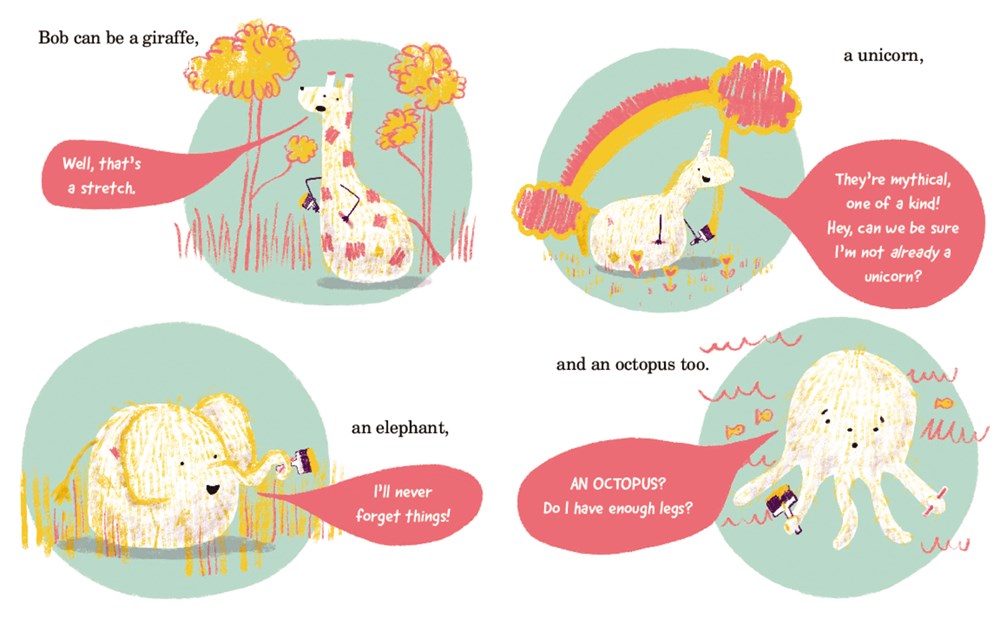
An illustrated page showing a character as a giraffe, an elephant, a unicorn, and an octopus
A page from Blob. Leaning into silly humor was fun!

    Halfway through the process of editing the manuscript, the pandemic began. As we all grappled with the fear and uncertainty of that time, my friendships moved to online forums, where I met more queer and trans authors and artists. For the first time in my life, I heard the word nonbinary. Hearing them describe their own experiences of self discovery, the old childhood uncertainty of making decisions about who I was and wanted to be began to bubble to the surface. I found myself relating to my friends’ stories and wrestling with questions about my own identity.

    As we worked on marketing materials for the book, including the book announcement, everyone was using he/him pronouns for Blob, which didn’t feel right. I asked that we switch to they/them pronouns. At the time, I wasn’t sure why I felt so strongly about this, but the publishing team immediately agreed and updated the marketing materials.

    After Blob was edited and the art completed, my editor asked me to write a letter to readers talking about what it meant to write Blob. In this letter, I discussed the many themes of my own childhood that had woven their way into this humorous story: the fear of deciding what and who to be, the pressure to be who people expected you to be, the disappointment of people not bothering to learn my name because I am a twin, and the frustration of people constantly misspelling my name. In short, Blob is about identity: being who you are, no matter what.

  
illustration of white blob character with star glasses on head wearing a name tag that says "hello my name is blob" and surrounded by drawings.
     
In writing this letter, I wrote “I hope that Blob shows children and their adults the importance of being yourself, regardless of what other people want or expect you to be. That the best answer to “what do you want to be” can be “I want to be me”! There are many children who deal with people mispronouncing their names, whose reality includes people making no effort to know who they are or say their names correctly, or whose name doesn’t fit who they are. I want children reading this book to realize that it’s ok to speak up and ask people to call you what you want to be called, to recognize you as an individual, no matter how many times it takes.”


    A lightbulb went off in my head as I wrote that. All those questions I had wrestled with while writing Blob suddenly had an answer. Blob was not only all the things I had written above, it was my journey of discovering that I am nonbinary. Blob’s feelings of not really being one thing or the other, being all the things yet none of the things was me. Writing Blob was like finding a mirror that truly reflected who I was for the first time in my life.

    I wasn’t able to share this story when Blob published, and yet Blob still found their way to nonbinary readers whose parents’ messages to me will forever remain close to my heart. I love that Blob can be so many things for readers who will come across this story, and that readers can connect to this character in their own way. For me, Blob will always be about discovering myself as a nonbinary person. Thank you, Blob.

   
Image of cover of picture book titled BLOB with white blob character in star glasses in the center.
My advice to other writers and illustrators: write what your heart is pulling you to write. Draw the character that makes you laugh, the character that demands attention. You may find yourself on the page, and this authenticity will connect to you to your readers. 

    I ended my letter to readers with “Blob captured my heart. I hope they capture yours as well.” And so I’ll end this post to you, writers and illustrators: Blob discovered my true self. I hope your writing and illustrating discovers yours as well. Always be you!


Image of person in star glasses and tunic top holding picture book titled BLOBAnne Appert (they/them ) is a nonbinary author/illustrator who spent their childhood with their nose stuck in a book, while their wild imagination transformed their New Jersey backyard into faraway places. Anne still enjoys spending time in their backyard dreaming, and now their imagination turns their dreams into words and pictures for children. Anne wrote and illustrated their debut book Blob, which was published by HarperCollins in Fall of 2021. Their second book What If You Wish? will publish with HarperCollins in 2024. They are a member of SCBWI, from which they received an honor in the 2021 Conference Portfolio Showcase. When not writing and illustrating, Anne enjoys teaching college students, dying their hair every color of the rainbow, and attempting to roller skate.  You can see their work at anneappert.com.


Thursday, November 3, 2022

Local Comics Expos in the Comics Ecosystem

Some of the best stories and art you’ll find will be at local conventions and expos. Some are run by nonprofits, such as the Small Press Expo, while others are run by colleges and universities to give their students a chance to show off and gain experience. 

These smaller shows are great opportunities to connect with small publishers, editors, artists, and writers in ways that can be difficult at larger conventions. It’s a lot easier to chat in a crowd of a few hundred instead of a few thousand! And these connections can be great to look back on when looking for people to collaborate with, or to simply find new friends in the space or authors and artists you admire.

These expos also often feature panels and demonstrations from working artists, where they can get into their process, techniques, and inspirations, and it’s easier to talk to them and ask more specific questions. These are great places to talk shop and learn more about the craft, whether you’re also a cartoonist or just want to explore the perspective. 


Artist’s tabling at these smaller conventions often show off more niche and experimental work. When I recently attended MICE 2022, I saw artists showing off mixed media comics, experimenting with format, and selling limited run prints, shirts, and, in one case, home-made cat toys to go with their books! (My cat definitely approves).


As an artist tabling, you can meet your table neighbors, which can include indie publishers, learn more about your local comics and book scene, and also test the waters with your original work! Many artists I spoke to had shorter 10-20 page comics that were test-runs of long-form, one-day-to-be graphic novels. These are great ways to get eyes on your work, and to also show proof-of-concept to anyone you pitch to. 

These conventions and expos are pillars in the comics industry. They’re great ways to meet peers and make friends with people with similar experiences, to learn and gain inspiration, and to get lay of the land on what’s popular and what speaks to you. Aside from that, is there really any better feeling than getting to talk to an author or artist about their work in person? Or having someone ask you to sign your zine or book?


Cindy Harris (she/they) is a comics artist and illustrator that works in the publishing industry. She has worked as a letterer, editor, illustrator, and writer, and loves stories about identity, relationships, and growth.

www.cyngharris.com


Tuesday, June 14, 2022

Kaz Windness Shares Advice and the story behind her writing/illustrating picture book debut, "Swim, Jim!"

Debbie Ridpath Ohi interviews Kaz Windness at Debbie's blog, and it includes so much great stuff. Like the wacky real-life origins of "Swim, Jim!"

two photos of a crocodile swimming in a canal on top of a yellow pool noodle, and a cartoon balloon of dialog next to a photo of Kaz saying "Please help me find Jim. I wrote him a book"

I particularly liked Kaz's advice for other authors and illustrators:

Children’s books is a career that requires a deep and abiding passion. It’s not like in the movies where you have a book idea one day and get a huge book deal the following week and save the family farm from foreclosure. SWIM, JIM! is my debut picture book, and I’ve been out of art school for 20 years this summer. It’s also not the kind of money that saves the farm. But it is a career that saves kids (books saved me!) so it’s worth being persistent– but only if it’s something you can’t not do. If you can’t quit, keep going. Your breakthroughs are coming!    

My advice for illustrators is cast a larger net for art inspiration. While it’s important to be on social media and also devour children’s literature, especially recent publications, if we only look Instagram and other picture books, we’re just stylistically regurgitating what’s already been done. Go to the museum. Get inspired by musical theatre. Fall down the rabbit hole of Victorian fashion or hip-hop music or cave paintings. You are standing on the creative shoulders of thousands of years of artists and its a proud and inspiration-rich heritage. That can all becomes compost and fertile ground to draw inspiration from.   

Read the full interview here.

Illustrate, Translate, and Write On,
Lee

Thursday, May 12, 2022

School visits: A few things I've learned along the way

school visit 3

I first started speaking at elementary schools in Iowa back in the early ‘90s, way before my first trade picture book published. At that time, I illustrated a lot of basal readers for educational publishing companies. My work soon got the attention of a local social service agency, who invited me to speak at elementary schools—whoa!? 


Like a lot of writers and illustrators, I was an introvert. And I was shy, too (there's a difference). The idea of talking to anyone other than myself or my mom was strictly out of the question. I mean, what would I talk about? Honestly, I knew the answer. Kids love art, and a visiting artist would be inspiring for them. Still, I needed time to get over my fear of public speaking.  


Fast forward thirty years later—I’m now way past my fear of speaking to large groups. In fact, believe it or not, I enjoy it. Today, I present at elementary schools all over the country—in person and virtually.  For me, there’s nothing more delightful than when I’m sharing my experiences with young readers. I love the excitement in their eyes when they meet “the author.” I love their interesting and over-the-top questions. And I love their letters and drawings that often follow. Here are a few things I’ve learned along my school visit journey:


First and foremost, visiting elementary schools is not a must. I’ve met many authors and illustrators

school visit2

who have no interest in presenting at schools, but somehow feel pressured to do so—for promotional reasons; or because their publishers asked them to; or because, they think, children’s authors are supposed to do so. But here’s the thing: don’t treat children like they’re a promotional opportunity. Visit schools out of a genuine love and caring for children. As authors and illustrators, we have this wonderful career because of the kids! So, if you’re going to visit schools, do so out of the spirit of love, teaching, edifying, and inspiring a lifetime appreciation of reading. Also, if kids really aren’t your thing (yes, I’ve met a few children's book authors who fall into that category), do kids a favor: Write books, but don’t visit schools. 


Don’t be boring. I know, that sounds kind of simplistic, huh? But seriously, if I had a dime for every teacher or librarian who confided in me that most author visits they’d experienced were boring, I’d have quite a few dollars built up. Author visits are a day that children will carry with them for a lifetime, so make the day special. Now I don’t mean that you have to juggle flaming torches to get kid's attention, but you do need to think about and plan, and to find a way to engage them. Some kids already think that books are boring—I mean, books have to compete with TikTok, Netflix, and Minecraft. So, don't do a boring author visit. Keep in mind, learning to engage children isn't going to happen on the first few visits—being an engaging speaker is a learning process. Take a speaking course. Join Toastmasters. Show up (ask permission) at a school when a visiting author is in your area. How does that author engage an audience? Think about yourself as a child—how could a visiting author have grabbed your attention?


school visit 1

Make positive connections. As much as author visit day is about you sharing with students, it’s also a day for students to share with you. So make connections. The simplest way to make a connection is through a smile. No matter what kind of crazy my life is before entering a school, once I pass through the doors, I’m going to connect with everyone through a smile. I want everyone to feel welcome around me, I want to leave a positive impression. You never know what kinds of monsters a child might be dealing with. A simple smile, eye-to-eye contact with a high-five or a wave, goes a long way.

In addition, while I’m presenting, I try not to keep the focus only on myself. I want the students to tell me about themselves too. What are they really good at? What are their special talents? I keep the presentation interactive—an ebb and flow of author and students sharing with each other. Once they’ve shared their dreams and aspirations with the author, you’ve made a meaningful connection.


Personal gender pronouns. Okay, I’ll admit, I was slow to understand the pronoun conversation. I’m 58-years-old. For the majority of my life, “they” and "them" were plural pronouns that quickly earned a bad grade in English class, if you used them in the singular. Visiting schools turned me around, though. There's no worse feeling than referring to a child as “he” and then having them correct you—in front of the entire class—as, “I’m a she,” or vice versa. That happened a few times, and I felt awful. I want to be respectful of every child who crosses my path, so I learned. And I changed. During a Q&A at a virtual school visit recently, a child thanked me for identifying my pronouns on my profile picture, saying to me in front of the entire class: “You made me feel safe.” I want every child to feel safe and respected.


Don Tate is the award-winning author and/or illustrator of numerous picture book biographies, including PIGSKINS TO PAINTBRUSHES: THE STORY OF FOOTBALL PLAYING ARTIST EARNIE BARNES (Abrams, 2021) and SWISH! THE SLAM-DUNKING, ALLEY-OOPING, HARLEM GLOBETROTTERS (Little Brown, 2020). His WILLIAM STILL AND HIS FREEDOM STORIES: THE FATHER OF THE UNDERGROUND  RAILROAD
 (Peachtree, 2020) was an SCBWI Golden Kite winner in the nonfiction category. Don is a founding host of the Brown Bookshelf, a blog dedicated to advocating for Black authors and illustrators writing for children. When Don isn’t writing, illustrating or visiting elementary schools, he enjoys working out, swimming, yoga, and anything sweet and chocolaty.

Thursday, March 31, 2022

Mike Curato shares the story behind the story of his new picture book (and why Bina Bear is Purple)

Over at his blog, Mike Curato shares the story behind the story of Where is Bina Bear?

From the doodles/sketches that started it all, 

sketches in Mike Curato's notebook of a bear character hiding their head in a paper bag and under their arms at a table
some of those sketches that inspired Mike's Bina Bear character

to the book dummy, to the illustration style and the meaning behind this story, it's a fascinating window into Mike's process. 

One highlight:

On the surface, Where Is Bina Bear? is a cute hide and seek book. One could read this book and quickly chalk it up to a funny story about a bear with social anxiety. But for me it’s even more about two people trying to be good friends as best they can with what they have to work with. Tiny sees past Bina’s anxiety with compassion and playfulness, and we come to learn that Bina only came to this party because of her love and loyalty to Tiny. In the end, the most important thing is being together, and the two find a creative way to do just that.

It's well worth checking out, and maybe inspiration for the rest of us to share the story behind the story of our books as well!

Illustrate, Translate, and Write On,
Lee

Tuesday, February 1, 2022

An Exclusive Interview with Author/Illustrator Eugene Yelchin

The cover of Eugene Yelchin's "The Genius Under the Table"

Eugene Yelchin is remarkable. His recent memoir, The Genius Under The Table, is as well. (It received seven starred reviews!) We connected to talk about memoir, craft, and much more...

Lee: There’s this really cool metaphor Barbara Kingsolver brought up in Animal, Vegetable, Miracle - speaking of fiction being like planting a garden in a desert, where you have to bring everything - rope off an area and then bring in soil, seeds, water, and tend it to grow into the garden you want. Nonfiction, Barbara offered, is more like going into an overgrown jungle, roping off an area and then taking everything that doesn’t belong in your garden out. When you’re looking at your whole life, how do you approach telling just a piece of it (like you did in”The Genius Under the Table”) in a way that crafts a story with a beginning/middle/end?

Eugene: It's a great metaphor, Lee. However, one still must decide what to take out of the roped off garden and what to keep. I have never written a memoir before. I have never written a nonfiction book before. The process was completely mysterious to me. But as I began working, I realized that a memoir requires a solid story structure not unlike a fictional story. The questions I had to ask myself were the same questions I ask myself when I write fiction. What are the wants and the needs of my characters? What is at stake? What are the obstacles, the complications? What is the crisis, climax, resolution? The Genius Under the Table is a very simple book. It is about tough things (poverty, fear, oppression), but somehow, it turned out to be funny. If I were to describe its plot, the book is about me becoming an artist. I thought a lot about what might have led me to the career in the arts and I talked to my brother a lot. We have realized that the most significant events that had influenced my artistic future occurred between the ages of six and sixteen. By the time I reached sixteen, it was fairly obvious to everyone in my family that I was not good at anything but making art. As a result, the memoir’s duration falls within that period, roughly a decade from mid-1960s to mid-1970s, which naturally, gave my story the beginning, the middle, and the end. 

Lee: Did you think of yourself (the child you) as a character?

Eugene: Absolutely. Every person in the book is a real person, and every event in the book is a real event, but I turned real people into characters, and I organized real events into a cause-and-effect structure. Unlike autobiographies, memoirs rely exclusively on one’s memory, but our memories are unreliable. To get closer to the truth, traditional memoirs include two voices: a voice of a young person experiencing the past, and a voice of a mature author commenting on those experiences from the present. If I were a ten-, twelve-, fifteen-year-old, I would have found some “mature author” explaining stuff to me unbearable. As a result, I removed my present-day self from the book all together. The story is told from the point of view of myself as a boy trying to make sense of the complicated world he’s inhabiting. Lost, confused, mistaken in his assumptions, mine is an unreliable narrator, who is probably more real me than I’m willing to admit.

An interior spread from "The Genius Under the Table".


Lee: How did the art come in terms of sequence - did you draw first, then write, or the reverse, or was it some combination as you went?

Eugene: The illustrations in the book are the re-enactments of my childhood drawings. As a kid, I used to draw to make sense of things. My family lived in one of those grim Soviet communal apartments, all five of us together in one room. I slept on a cot under the table, and it was the underside of that table that served as my drawing surface. I vaguely remembered my drawings on that table, which, naturally, had to be adjusted to the needs of the narrative. When I was making the finished illustrations for the book, I already knew what I needed, but while I was still working on the manuscript, I would doodle on the reverse of a printed page, figuring out my next move. On occasion, those scribbled images suggested solutions to the problems in the text that I was trying to solve.

Another interior spread from "The Genius Under the Table."


Lee: There’s so much as children we don’t understand and that can seem really scary, to the point where we adults writing for children can want to explain everything… Letting the child you not understand things felt very real, and also brave of you as the adult creator of the work. Can you speak about that?

Eugene: I had never assumed that I could impart some significant knowledge to my readers. I can barely figure out stuff for myself. I worry that explaining the complexity of our thinking and our actions may take away from that complexity. Our job as writers is not giving answers, in my opinion, but asking questions. The more difficult the questions are, the better. Our job is putting our readers in situations which engage their moral barometer. Our readers must ask themselves: what would I do if I were in the protagonist’s shoes? How would I react to such and such statement or action? What is the right thing to do in such and such situation? Naturally, I take sides in the moral dilemmas of the stories I write, but I prefer for the readers to infer where I stand from the dramatic situations instead of my observations.

Lee: What advice might you offer other illustrators and writers as they approach crafting their own memoirs?

Eugene: I’m not sure I’m very useful as an adviser. But there are some obvious things I could mention: 1) Know what you are writing. Is it a memoir or an autobiography? 2) Remember that most people have some kind of childhood traumas. If you’re writing from the place of trauma, show us your effort to overcome it. Please, please, please, do not write from a position of a victim. 3) Stay away from nostalgia like from a plague. 4) Try to distinguish between real events in your life and the events you wish to be real.  5) Most importantly, try to tell the truth to yourself. The rest will follow.

Thank you, Eugene! 


Illustrate, Translate, and Write On,
Lee

Thursday, October 15, 2020

Learn How To Draw a Face -- and Eyes! -- From Caldecott Award-winning Paul O. Zelinsky (courtesy of the Society of Illustrators)

Check out Paul's art tips in this remarkable video (it says it's part of their "Draw Along Videos" for kids but really it's for anyone interested in drawing people -- at whatever age you are.)


A Screen Shot from "Draw This! Paul O. Zelinsky"

The bit about where the pupil goes and how the eyelid is affected made me realize three things:

1) Paul is a seriously amazing illustrator.

2) To draw well, you really need to observe carefully - and illustrate what you see, not what you think you see.

3) I could observe faces more carefully.

I hope you'll enjoy this, too! (Click to learn more about Paul and watch the video.) 

Illustrate and Write On,

Lee


Tuesday, May 26, 2020

Listen to the Latest SCBWI Podcast: A Conversation with Raúl the Third


Raúl the Third is a Pura Belpré medal award-winning illustrator of graphic novels and author/illustrator of picture books and soon, early readers. In this conversation with Theo Baker, Raúl discusses his connection to art, shares some of the strategies he uses in illustrating, and recounts his path to building his own universe of characters and stories.

Listen to the episode trailer here.

Current SCBWI members can listen to the full episode here (log in first).

Illustrate and Write On,
Lee

Thursday, March 5, 2020

"Do You Want To Create A Picture Book?" - A Panel Discussion with Nate Williams, James Yang, Giuseppe Catellano, Jim Hoover, and Kirsten Hall

"Picture books are kind of like the guitar solo for illustrators."

With those words of inspiration (or maybe challenge), author and illustrator Nate Williams kicked off this panel discussion at the Society of Illustrators. In this video recorded on February 10, 2015, Nate outlines his creative process—from ideation to publishing. He is joined by James Yang (Author/Illustrator http://www.jamesyang.com), Giuseppe Catsellano (at the time an Art Director, Penguin Young Readers Group http://twitter.com/pinocastellano), Jim Hoover (Associate Art director, Viking Books), and Kirsten Hall (Agent/Producer http://catbirdagency.com/).


As shared on the Society of Illustrators video archive.

Illustrate and Write On,
Lee

Thursday, February 27, 2020

Listen to the Latest SCBWI Podcast - A Conversation With Juana Martinez-Neal


“In 2012, Juana Martinez-Neal won the Portfolio Showcase Grand Prize at the SCBWI Los Angeles conference. Today, she is a multi-award winning author/illustrator. Alma and How She Got Her Name” (Candlewick Press) was her debut picture book as an author-illustrator, and was recently awarded the 2019 Caldecott Honor!


Juana illustrated “La Princesa and the Pea” (written by Susan M. Elya, Putnam/Penguin), winner of the 2018 Pura Belpré Medal for Illustration, and “Fry Bread: A Native American Family Story” (written by Kevin Noble Maillard, Roaring Brook Press), winner of the 2020 Robert F. Sibert Medal.

In this exclusive conversation with Theo Baker, Juana shares about her childhood in Peru, her path to children's books, the many media she's worked with to create her illustrations, and balancing family responsibilities with creative time.

Listen to the episode trailer here.

Current SCBWI members can listen to the full episode here (log in first).

Illustrate and Write On,
Lee

Tuesday, January 14, 2020

David Mackintosh's top 10 illustration and design tips for picture books - via The Guardian

David Mackintosh's top 10 illustration and design tips was published a few years ago, but the tips are solid, 'evergreen', and well worth considering.


 Here's just two that really resonated:
Tip 1 – How to keep ideas: If I think of something for a book, I'll write it in a notebook. It could be a title I like, or something I overheard on the tube or just an idea that I can build a story around. Often I just carry a story about in my head for ages, working on it in there until I sit down at the laptop or with a pencil to get it going. I find it quicker to play with the ideas using a pencil on paper, than typing on my laptop (see Tip 3).
and
Tip 5 – Turn up the contrast: A busy page with a lot of words on it followed by a page with a tiny ant on it and no words can be very dramatic. Contrast makes things interesting and avoids it being repetitive. Also, a page without text can really create atmosphere. It places all the emphasis upon the picture and the reader is on their own with the information they're getting from that picture. It's very effective and can be used to alter rhythm and pace in the story in different ways. A bit like music in a film.
Read the full piece here. 

Illustrate and Write On,
Lee